
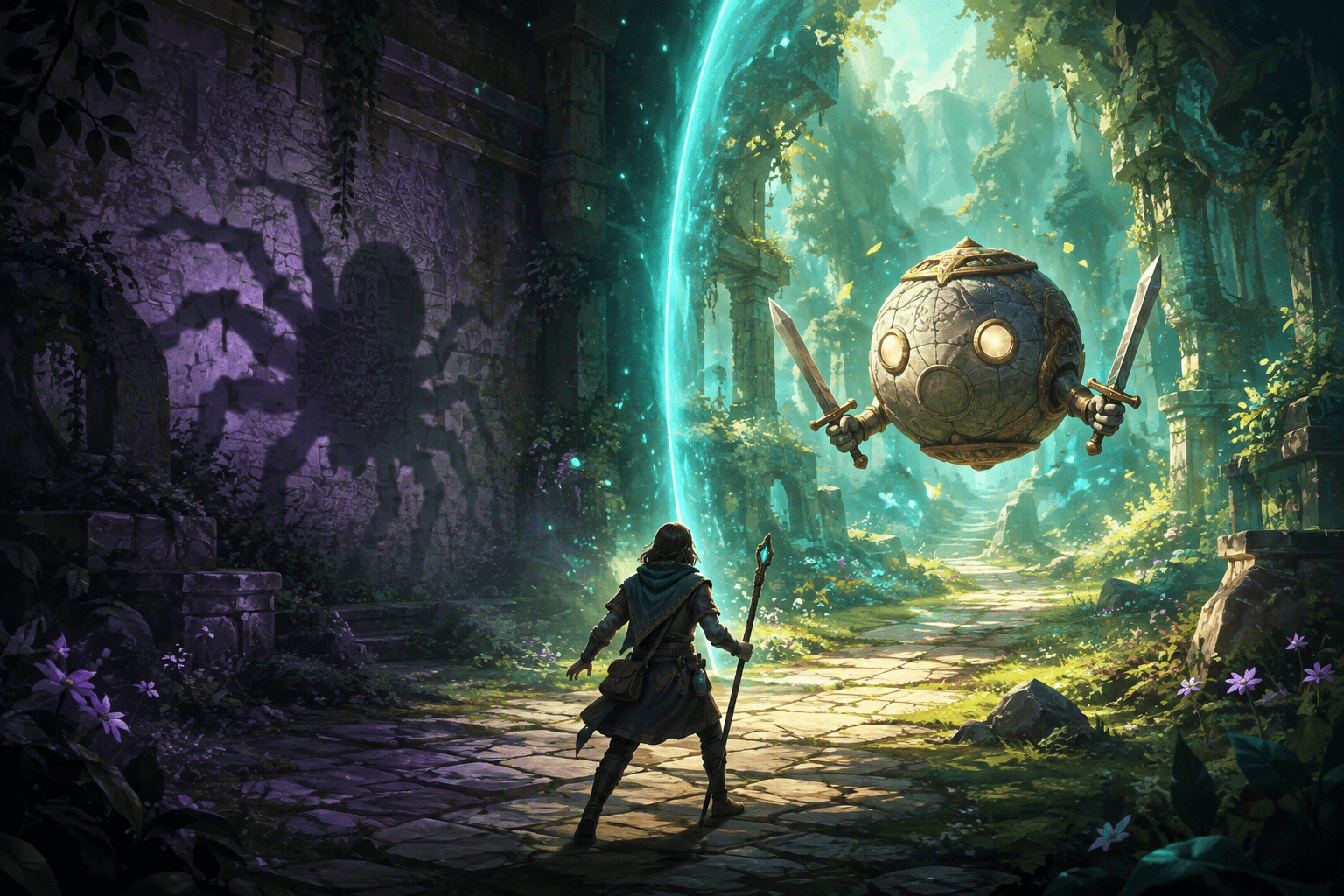
Arachnophobia settings can work in several fundamentally different ways. A game might remove spider enemies, change a few anatomical details, replace them with another creature, or leave the enemies intact while reducing their visual prominence. These approaches do not provide the same level or type of support.
Avowed uses direct visual replacement. Its Arachnophobia Mode changes spider enemies into round, floating orbs that carry swords. Obsidian emphasizes that the replacement enemies remain dangerous. The setting changes what the enemies look like, not whether the player must encounter and fight them.
A feature added after launch
Arachnophobia Mode was not part of Avowed’s original February 2025 release. Obsidian added it in Update 1.4 on May 15, 2025 following community requests. Players using an older installation therefore need to update the game before expecting to find the option.
The setting is located in the Accessibility menu and can be toggled. When it is active, spiders are replaced with round floating orbs wielding swords. Obsidian’s patch description deliberately notes that their appearance may be friendlier while their attacks remain deadly.
Because the option arrived through an update, older reviews and launch-day accessibility lists may correctly omit it while no longer representing the current game. This is a useful reminder that accessibility information can become outdated even when the original reporting was accurate. Current patch documentation is necessary when checking whether a post-launch feature is available.
This is a built-in feature rather than a third-party mod. It does not require replacing files, installing an unofficial package, or managing compatibility with a mod loader. Its post-launch status still matters, however: availability depends on running a version of the game that includes Update 1.4 or later.
Replacement rather than removal
The most important distinction is that Arachnophobia Mode replaces the enemy’s visual form. The relevant encounters remain in the game. A transformed enemy still occupies space, moves through the encounter, attacks, and must be avoided or defeated according to the same basic progression requirements.
Removing spiders entirely could affect encounter balance, routes, rewards, and other systems. Substituting a differently shaped enemy allows the encounter to remain functional while changing its most obvious arachnid presentation. This can preserve progression without requiring the player to confront the original model.
The replacement should not be described as a skip. The player does not bypass spider encounters or receive automatic completion. It is also not invincibility: the orb can still damage the player. Someone whose main barrier is combat difficulty may need other settings in addition to Arachnophobia Mode.
What the floating orb changes
A round floating form removes several common visual characteristics associated with spiders. It does not present a many-legged silhouette, crawling leg movement, or the low-to-the-ground body shape typically used for an arachnid enemy. Giving the replacement swords makes its hostile role visually legible even though it no longer resembles the original creature.
That clarity matters. An accessibility replacement still needs to communicate where the threat is and what it is doing. A completely abstract or invisible substitute might reduce exposure to the original creature but introduce new barriers involving target tracking, attack recognition, and collision.
The orb remains a fantasy enemy rather than a neutral placeholder. It can still approach the player and participate in combat. Some players may find the substitute substantially easier to tolerate, while others may still experience discomfort from its movement, sound, speed, or knowledge of what it replaces.
The replacement also retains a clear direction and combat posture through its swords. This may help distinguish an active enemy from decorative floating objects elsewhere in a fantasy environment. The mode changes the source of the visual barrier while preserving information the player needs to respond.
Visual reduction is not complete trigger removal
Obsidian documents the visual replacement but does not state that the setting removes every associated sound, animation, encounter pattern, narrative reference, environmental trace, or spider-related concept. It would therefore be inaccurate to promise that all arachnid cues disappear.
An enemy can evoke a spider through more than its model. Movement patterns, attack timing, sound design, location, or the structure of an encounter may contribute to the association. Without official documentation specifying that those elements are changed, players should treat the mode as a model replacement with defined visual characteristics rather than a comprehensive trigger filter.
The feature also does not establish that every spider-like image in scenery, text, dialogue, icons, or decorative art has been replaced. Obsidian’s description specifically concerns spider enemies. Players who need broader removal may still encounter material outside that documented scope.
Which barriers it may address
A realistic or stylized spider enemy can make a game difficult or impossible to approach for some players. The barrier may involve fear, panic, disgust, intrusive anticipation, or a strong sensory response to body shape and leg movement. Direct substitution may allow a player to enter an area or complete a quest that they would otherwise avoid.
The option may also reduce uncertainty once it is enabled. A player who knows that enemy spiders will appear as orbs may spend less time anticipating an unexpected detailed model. This can make exploration more manageable for some people, although the setting cannot guarantee the absence of all personally relevant cues.
Individual responses to phobia-related features vary considerably. Some players may need only a less detailed model. Others may require total removal of spider references, sounds, or behavior. A spherical replacement that works well for one person may not be sufficient for someone else, even when both describe their barrier as arachnophobia.
Combat remains active
Because the replacement remains dangerous, the player still needs to manage the combat encounter. This may involve aiming, attacking, blocking, dodging, selecting abilities, tracking other enemies, or maintaining distance. The mode does not reduce the number of required inputs or document any automatic defensive response.
The visual replacement could indirectly change how readable the encounter feels. A floating sphere has a different silhouette from a multi-legged creature, and its sword provides a recognizable sign of hostility. However, Obsidian does not state that the mode enlarges hitboxes, slows attacks, reduces damage, or otherwise changes combat mechanics.
Players who need both visual replacement and reduced combat pressure can adjust difficulty separately. The game’s current custom difficulty options allow several enemy and player values to be changed, including enemy damage, health, and speed as well as player damage and available resources. These affect challenge, while Arachnophobia Mode affects the enemy’s presentation.
Combining it with third-person play and camera controls
Avowed includes both first-person and third-person play. A different perspective may alter the apparent size of an enemy and how close it feels to the camera. Arachnophobia Mode remains the option specifically documented to replace spider enemies, while perspective changes how the entire game is viewed.
Camera Shake, head bobbing, and camera sway can be disabled separately, and Field of View can be adjusted. These controls may be relevant if rapid enemy movement or camera motion adds to a player’s sensory discomfort. None of them substitutes for the orb replacement, because they leave the original creature model unchanged when Arachnophobia Mode is off.
Third-person perspective can also create different visual demands, including a visible player character and a wider view of the surrounding battlefield. A player may prefer first person with the replacement enabled, third person with the replacement enabled, or another configuration. There is no single required combination.
What the mode does not change
Arachnophobia Mode does not make Avowed free from threatening fantasy creatures. Other enemy designs, environmental hazards, combat effects, and unsettling locations remain. The floating replacement itself carries weapons and is meant to communicate danger rather than become harmless decoration.
It does not remove the need to explore areas where spiders ordinarily appear. If an enemy guards a route, objective, or item, the orb replacement can still occupy that role. The player may need to approach the same location and complete the same underlying encounter.
The mode also does not remove timing, targeting, or motor demands. It changes the form being perceived, not the controls used to respond. Full control remapping and analog sensitivity adjustment may help with some input barriers, but those are separate systems.
Platforms and current availability
Avowed is currently available on Xbox Series X|S, Windows PC through multiple storefronts, Xbox Cloud Gaming, and PlayStation 5. The PlayStation 5 version launched on February 17, 2026 with the preceding year of game updates included. Xbox and PC players should keep the game updated to ensure that post-launch features such as Arachnophobia Mode are present.
Obsidian’s official Update 1.4 announcement for Avowed provides the clearest description of the setting: spider enemies become round floating orbs with swords, but remain dangerous. The accompanying official patch notes likewise identify the feature as an Accessibility-menu toggle.
A different enemy shape, not an absent encounter
Avowed’s approach preserves encounter structure while replacing a potentially inaccessible creature model. The floating orb offers a visually distinct enemy with a readable weapon, allowing combat to continue without the original spider form.
Access needs vary, and this mode has a specific practical boundary. It replaces spider enemies visually; it does not document removal of every spider-related cue, reduce their danger, automate combat, or guarantee that the resulting encounter will be comfortable for every player.