
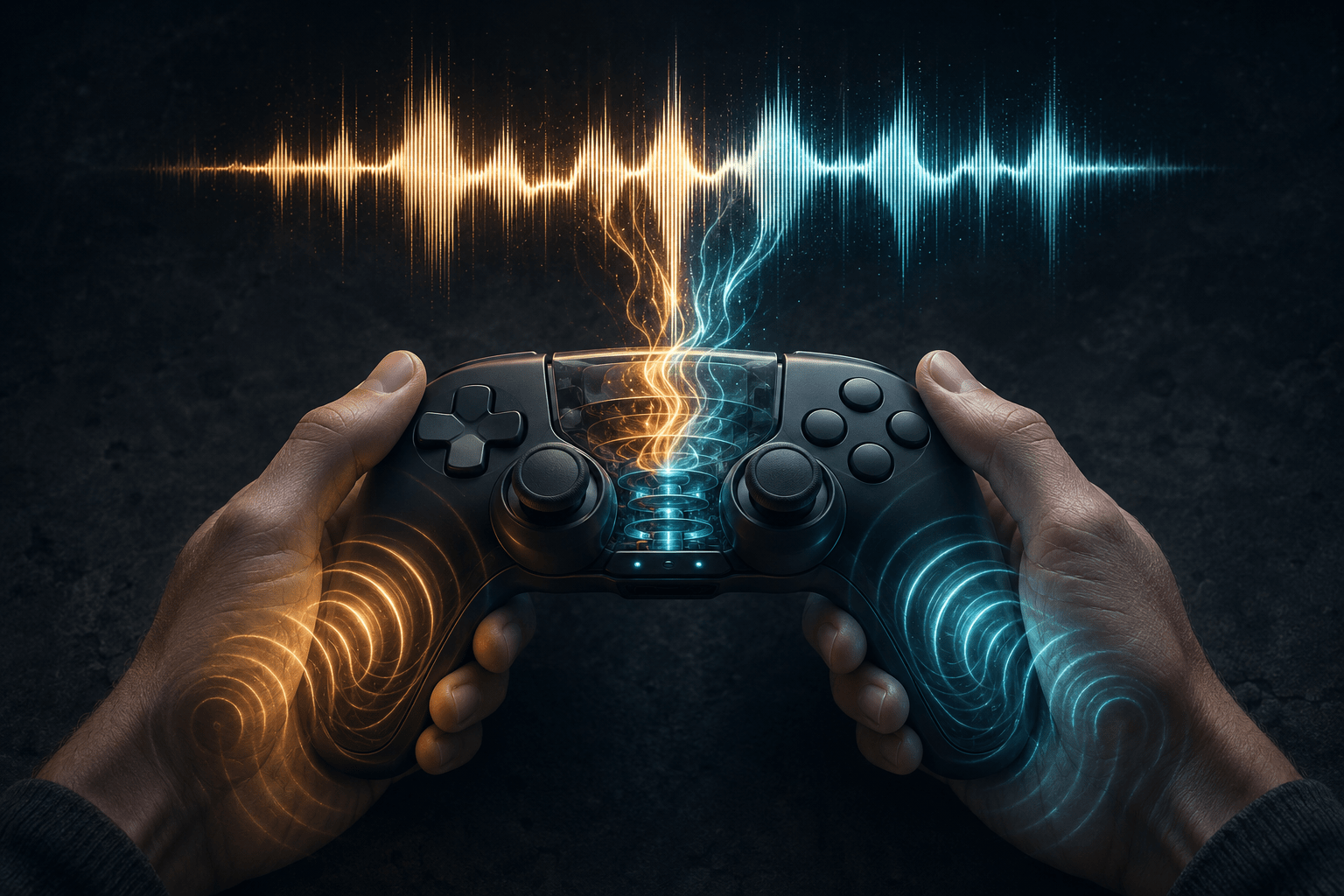
The Last of Us Part II Remastered includes a feature called Speech to Vibrations that converts spoken dialogue into haptic feedback through a compatible controller. Instead of using vibration only for impacts, weapons, or environmental events, the feature allows the player to feel patterns corresponding to how a line is delivered.
Speech to Vibrations is intended to work alongside dialogue, subtitles, and other accessibility options. It does not translate words into a tactile language and cannot replace the semantic information contained in subtitles. Its purpose is narrower: to communicate selected qualities of vocal performance, such as rhythm, emphasis, pauses, and changes in intensity, through touch.
This distinction makes Speech to Vibrations an unusual hearing-access feature. Most games use controller vibration to reinforce physical action. Here, haptic feedback becomes an additional channel for expressive information that is ordinarily carried by a speaker’s voice.
Dialogue contains more than words
Subtitles communicate what a character says, but spoken performance can also communicate how the line is delivered. Timing, stress, hesitation, volume, pacing, and changes in vocal intensity may affect how a player interprets a conversation. The same words can express anger, uncertainty, urgency, humour, exhaustion, or restraint depending on their delivery.
Some subtitle systems add speaker names, punctuation, positioning, or descriptive annotations to communicate part of this context. However, subtitles do not consistently represent every shift in vocal rhythm or emphasis. Adding detailed performance descriptions to every line could also make subtitles longer, denser, and more difficult to read before the dialogue advances.
Speech to Vibrations provides a parallel channel. According to Naughty Dog’s explanation of the system, spoken dialogue is played through the controller as haptic feedback so the player can feel how a line is delivered. Stronger or changing vocal energy can produce a different tactile impression from a quiet or evenly paced line.
The vibrations do not assign a fixed meaning to every pulse. A particular pattern does not universally mean that a character is frightened, angry, or lying. Interpretation still depends on the words, scene, performance, and other available context.
Speech haptics are not tactile subtitles
Describing Speech to Vibrations as “subtitles through the controller” would overstate what it communicates. The feature does not encode letters, words, or complete sentences into distinguishable vibration patterns. A player cannot determine the exact dialogue from the controller alone.
Subtitles continue to provide the linguistic content. In The Last of Us Part II, they can include story dialogue or both story and combat dialogue. Players can also adjust subtitle size, background, colour, speaker names, name colours, and directional information for offscreen speakers.
Speech to Vibrations adds information about delivery rather than duplicating the written line. A deaf player might read the words while feeling their cadence through the controller. A hard-of-hearing player may combine audible speech, subtitles, and vibration. Another player may use the feature at low volume to retain some sense of vocal rhythm without relying entirely on sound.
The feature may also be useful when environmental audio competes with dialogue or when a player’s audio equipment does not reproduce vocal detail clearly. Individual benefit will vary, and the vibrations are not equivalent to hearing the original performance.
It is different from ordinary controller rumble
Controller vibration is traditionally associated with physical events. A weapon recoils, an explosion shakes the environment, a character receives damage, or a vehicle crosses an uneven surface. These effects reinforce something happening in the game world.
Speech to Vibrations has a communicative purpose. Rather than simply vibrating whenever someone speaks, the controller attempts to reflect characteristics of the spoken performance. The changing tactile pattern is the information, not merely a notification that dialogue is occurring.
This also distinguishes the feature from a basic dialogue alert. A single repeated buzz could tell the player that someone has started speaking, but it would not preserve variations within the line. Speech haptics are intended to follow the delivery over time.
Nevertheless, the system still uses the same physical channel as other controller feedback. Gameplay impacts, weapon effects, environmental haptics, and speech vibrations may occur within the same broader experience. Players may need to adjust vibration categories or intensity to keep dialogue feedback distinguishable and comfortable.
Speech to Vibrations and combat vibration cues serve different purposes
The original PS4 release of The Last of Us Part II already included selected vibration-based accessibility cues. Combat vibration cues can communicate events associated with aiming, enemy attacks, or landing shots. Guitar vibration cues can indicate when the correct note for story progression has been selected.
These cues represent discrete gameplay events. A particular vibration confirms or warns that something has happened. They are comparable to accessibility audio cues, except the information is delivered through touch.
Speech to Vibrations is continuous and expressive rather than event-based. It follows spoken dialogue instead of signalling a single combat state. Feeling the delivery of a conversation does not tell the player that an enemy is attacking, just as a combat vibration cue does not communicate the emotional rhythm of a sentence.
The systems may be combined, but they should not be treated as interchangeable. A player may want dialogue haptics without additional combat vibration, or combat cues without speech patterns. The usefulness of each depends on what information the player needs and how easily different vibration types can be distinguished.
It does not replace audio description
The Last of Us Part II Remastered also adds descriptive audio. Audio description provides spoken narration of important visual information during cinematics. It may identify actions, expressions, environmental details, or changes that are not communicated through dialogue alone.
Speech to Vibrations does not describe any of those visual events. It converts the delivery of existing speech into touch. If a character silently enters a room, exchanges an expression, picks up an object, or reacts without speaking, dialogue vibration does not explain that action.
The two features therefore move information in different directions. Audio description converts visual information into spoken sound, while Speech to Vibrations converts qualities of spoken sound into tactile feedback. Blind or low-vision players may use audio description; deaf or hard-of-hearing players may use subtitles and speech haptics. Some players may use both when they have combined sensory access needs.
Combining vibration with customized subtitles
Speech to Vibrations may be most informative when paired with subtitles configured for the individual player. Speaker names identify who is talking, while name colours can create another visual distinction between speakers. Subtitle direction can indicate where an offscreen speaker is located relative to the screen.
Combat dialogue subtitles extend written coverage beyond principal conversations and cinematics to additional enemy speech during stealth and fighting. That matters because enemy dialogue can reveal awareness, searching behaviour, coordination, or changes in combat state.
Vibration can then add a tactile layer to the spoken delivery. The player receives the words visually, location through directional information when available, and elements of cadence or emphasis through touch. These channels reinforce different parts of the same communication rather than repeating identical information.
Using several channels can also create overload. Reading subtitles, monitoring combat indicators, interpreting vibration, and responding to gameplay may be demanding when they occur simultaneously. Some players may prefer to disable speech haptics during combat or reduce other controller feedback so the tactile information remains easier to interpret.
Possible barriers the feature may address
Speech to Vibrations may support deaf and hard-of-hearing players who want access to more of the performance information surrounding written dialogue. It may reduce reliance on audio for recognising changes in vocal intensity or pacing. It can also provide redundant feedback when dialogue is difficult to hear because of background sound, low playback volume, or an unsuitable listening environment.
Some players with auditory processing differences may find tactile rhythm useful when following spoken dialogue. Others may find simultaneous speech, text, and vibration distracting. The presence of another sensory channel should not be assumed to improve comprehension for every player.
The feature may also support play without headphones or at reduced volume, although it does not reproduce all audio information. Music, ambient sound, enemy movement, spatial audio, and non-speech sound effects are outside its specific purpose.
It is therefore more accurate to describe Speech to Vibrations as a supplement to dialogue access than as a general replacement for game audio.
Tactile sensitivity creates a different accessibility consideration
Controller vibration can present barriers for people with tactile hypersensitivity, pain, neuropathy, reduced grip tolerance, fatigue, or conditions aggravated by repetitive physical stimulation. Speech is frequent in The Last of Us Part II Remastered, so dialogue-based vibration may occur for longer periods than an occasional impact effect.
Naughty Dog’s documentation for the same Speech to Vibrations system in The Last of Us Part I describes an on-or-off setting with adjustable intensity within the controller vibration options. The broader vibration menu also separates categories such as gameplay, player actions, weapons, enemy attacks, environmental events, cinematics, accessibility cues, and speech.
These controls are important because lowering overall vibration is not the same as adjusting speech feedback independently. A player may want strong accessibility cues but minimal weapon rumble, or noticeable speech vibration with reduced environmental effects.
Some players will still need vibration disabled entirely. Speech to Vibrations is optional, and The Last of Us Part II Remastered remains playable without controller vibration. The feature should not become the only way essential dialogue information is communicated.
Platform and controller restrictions
Speech to Vibrations was added to The Last of Us Part II Remastered, not retroactively to the original PS4 edition of The Last of Us Part II. The Remastered version is available on PlayStation 5 and PC.
On PlayStation 5, the feature uses the DualSense wireless controller’s haptic-feedback hardware. A different controller may not reproduce the same patterns or expose the required haptic functionality.
The PC version supports DualSense integration, but PlayStation’s official product documentation specifies that a wired connection is required to experience the full range of in-game DualSense features. Players using another controller, a wireless connection, keyboard and mouse, controller-emulation software, or a device without comparable haptic hardware may not receive Speech to Vibrations as intended.
This hardware dependency is a meaningful limitation. Subtitles can be displayed through the game itself, but speech haptics depend on a compatible physical device, connection method, vibration settings, and the player being able to perceive the controller’s feedback.
What the feature communicates—and what it does not
Naughty Dog’s official overview of the Remastered edition identifies Speech to Vibrations as one of its added accessibility features. PlayStation’s explanation of the same system describes dialogue being reproduced through haptic feedback so a player can feel how the line is delivered.
The feature communicates an approximation of vocal rhythm and emphasis. It does not provide the dialogue’s words, identify the speaker, explain visual action, communicate every emotional nuance, or reproduce the full sound of a performance. Those functions remain divided among subtitles, speaker labels, directional indicators, audio description, and the original dialogue track.
Access needs vary, and tactile dialogue may be informative for some players while being distracting, uncomfortable, or imperceptible for others. Speech to Vibrations offers an additional route to selected performance information, but its practical value remains limited by individual tactile perception, controller compatibility, intensity preferences, and the need for subtitles or audio to communicate the words themselves.