
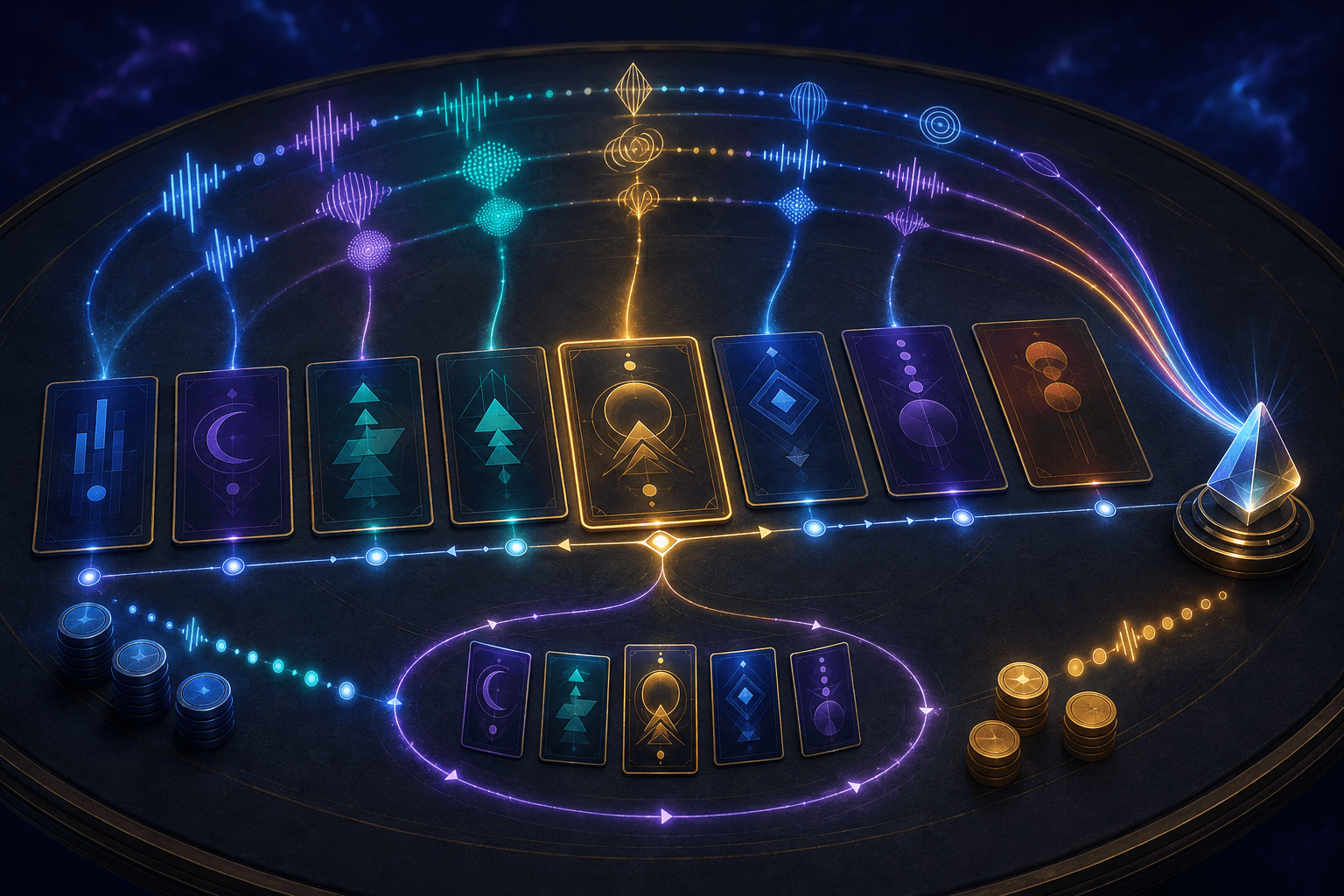
Balatro is a strategy game built around information. Players examine cards, arrange hands, compare scoring possibilities, manage limited discards, select Jokers and consumables, monitor money, and respond to restrictions imposed by Boss Blinds. Although its turn-based structure removes the reaction-speed demands found in many games, most of this information is ordinarily presented through a visual interface.
Blindfold is a community-created accessibility mod that converts those screens, controls, and changing game states into structured screen-reader output. It does more than speak the text printed on individual cards. The mod introduces a consistent keyboard and controller navigation model, announces scoring events, provides shortcuts for important status information, and stores selected details in review buffers so players can read them again at their own pace.
The result is a nonvisual interaction layer designed specifically around how Balatro works. It does not simplify the game’s strategy or automatically choose cards. Instead, it attempts to make the information and controls required for those decisions available without sight.
Why reading card names is not enough
A basic text-to-speech tool can read text that has been exposed correctly, but a card game also depends on relationships between objects. Players need to know which card currently has focus, where that card sits in the hand, which cards have been selected, what controls are available, and how an item can be moved relative to its neighbours.
Balatro adds further layers of information through Jokers, enhancements, editions, seals, consumables, vouchers, Blind restrictions, money, hand limits, discard limits, and an animated scoring sequence. The usefulness of one card may depend on the cards positioned before or after it. A screen reader that merely announces disconnected labels would not communicate enough structure to support informed play.
Blindfold addresses this by creating its own navigable representation of each game screen. Controls are organized into rows. Up and down move between rows, while left and right move among the controls within the current row. As focus moves, each control is spoken. This creates a predictable spatial model rather than requiring the player to search an inaccessible visual layout.
The approach resembles keyboard navigation in an accessible application, but it remains tailored to the game. On the play screen, the navigation order moves through Jokers and consumables, the current Blind, played cards, the player’s hand, and then the available action buttons. That sequence exposes both the strategic resources and the controls needed to act on them.
Selecting and playing a hand remains a player decision
When focus reaches a card in the player’s hand, Enter on a keyboard or the A button on a controller selects it. The player can select the desired cards and then use a separate command to play the hand or discard the selection. Blindfold announces the relevant objects and actions, but it does not identify an optimal poker hand or decide which cards should be played.
This is an important distinction between access and automation. The mod communicates the state of the cards and provides operable controls. The player still evaluates ranks, suits, enhancements, Joker effects, scoring opportunities, and the consequences of spending a limited hand or discard.
That preserved decision-making matters in Balatro because much of the game’s challenge comes from combining imperfect resources. A potentially strong hand may conflict with a Boss Blind restriction. Discarding may improve the cards in hand but consume a limited resource. Buying one Joker may mean passing over another. Blindfold makes these choices available through speech without resolving them automatically.
The mod therefore differs from an audio-description track. Audio description usually narrates visual action or appearance. Blindfold exposes interactive objects, their game-relevant properties, and the commands available to the player. Its output functions as an interface rather than a descriptive supplement to a primarily visual interface.
Reordering cards requires explicit spatial information
Card order can affect scoring. Jokers may activate from left to right, and the order of cards in a played hand can matter when different effects interact. Dragging a card visually is relatively intuitive because the player can see its starting point and intended destination. Recreating that operation without sight requires more explicit feedback.
Blindfold provides a pick-up-and-place process. The player focuses a card, activates the pick-up command, moves to the intended position, and activates the command again to place it. Spoken feedback describes where the card will be inserted, including its relationship to neighbouring cards.
This is navigation guidance rather than route automation. The mod does not independently sort cards or determine the most beneficial order. It makes the positions available so the player can perform the rearrangement deliberately.
The same mechanism works with hand cards, Jokers, and consumables. Providing one consistent interaction pattern across these groups may reduce the need to learn unrelated movement commands for every screen. It can also make accidental reordering less likely because the destination is communicated before placement.
Play-by-play scoring makes an animated process inspectable
Scoring in Balatro is not always represented by a single final number. Cards, Jokers, enhancements, multipliers, retriggers, and other effects may activate in sequence. Watching that process can help a player understand why a hand produced a particular result and whether the current build is working as expected.
Blindfold adds play-by-play scoring announcements. Instead of reporting only the final score, it can speak events as the scoring sequence develops. This may help players identify which cards and effects activated, follow changes to chips and multipliers, and understand the contribution of different parts of a build.
The announcements are configurable individually. This matters because complete narration can create its own accessibility cost. A highly developed run may contain many repeated effects, and speaking every event could become slow, cognitively dense, or difficult to follow. Per-announcement toggles allow players to reduce selected output rather than treating scoring narration as entirely on or entirely off.
Spoken detail does not necessarily make a complicated scoring system simple. Players still need to understand how Balatro combines chips, multipliers, card effects, and Joker abilities. The announcements can expose the sequence, but they do not replace learning the underlying rules.
Status shortcuts reduce navigation for frequently needed information
Several numbers must be checked repeatedly during a round. These include hands remaining, discards remaining, the current score and target, available money, and occupied Joker slots. Reaching each value through ordinary screen navigation would add substantial repetition.
Blindfold assigns direct status commands to these values. A player can request one piece of information without leaving the current card or navigating through the entire play screen. Keyboard shortcuts use Control with another key, while controller commands use combinations involving the triggers and face buttons.
These shortcuts may reduce navigation time, memory demands, and the risk of losing the current position. They also let the player choose when information is spoken. This differs from having every status value repeated automatically after each action, which could produce excessive audio.
However, chorded controls may present motor barriers of their own. Holding a modifier or trigger while pressing another button requires simultaneous input. Blindfold addresses some of this limitation by making its commands rebindable, but remapping changes where an action is located; it does not necessarily convert a simultaneous chord into a single-input action in every configuration.
Review buffers separate access from listening speed
Live screen-reader announcements can disappear as soon as the next event occurs. If several pieces of information are spoken in quick succession, a player may miss a detail because of attention switching, unfamiliar terminology, speech rate, auditory processing, or interruption.
Blindfold’s review buffers retain selected information so it can be revisited. The player can switch between buffers for game status and card detail, then move through their contents line by line. This allows information to be examined after its original announcement instead of requiring immediate recall.
The difference between repetition and persistence is important. Repeating a live announcement merely plays it again at that moment. A review buffer gives the player control over which line to inspect and when to move forward or backward. It converts transient speech into a navigable information resource.
This may support blind and low-vision players, but it may also reduce working-memory and processing demands for some players who prefer speech over dense visual text. Individual experience will vary, and speech output can become overwhelming when too much information is presented without sufficient filtering.
Keyboard and controller support are built into the mod
Blindfold supports both keyboard and controller navigation. Directional inputs move through controls, dedicated commands select, play, discard, sell, or use items, and additional inputs open deck and run information. The mod’s keybindings can be changed through its own options.
Controller support is significant because screen-reader access alone does not make a mouse-oriented interface physically operable. A blind player must be able to reach every necessary control through a predictable non-pointer input method. The row-based navigation system replaces the need to locate and click visual coordinates.
Full rebinding may also help players who have difficulty reaching the default keys or controller combinations. It can support alternative layouts, one-handed configurations, or reduced travel between controls. Compatibility still depends on the physical device, the operating system, and how the player’s chosen hardware presents its inputs to the game.
Blindfold does not add universal support for every adaptive controller or input method. Rebindable game commands and physical-device compatibility are related but separate issues. External software or hardware configuration may still be required.
Blindfold is a third-party Windows PC modification
Blindfold is not a built-in Balatro accessibility setting. It is an unofficial community mod that changes the Windows PC version through the Lovely Injector mod loader. The supplied installer is designed to locate a Steam installation automatically, although it also provides a browse option when the game is stored somewhere unusual.
The documented manual installation places a Windows DLL beside the game executable and the Blindfold folder inside Balatro’s application-data Mods directory. The installer can also update or remove the mod. During uninstallation, it offers to remove the Lovely Injector and Blindfold settings without deleting the player’s game saves.
Because this is a PC mod, it does not add screen-reader support to the Nintendo Switch, PlayStation, Xbox, or mobile releases. The official Balatro FAQ lists those versions, but the console and mobile editions cannot use this Windows mod installation process. The project documentation also does not provide an equivalent supported installation procedure for the macOS version.
Windows may display a SmartScreen warning because the installer is not code-signed. Players must decide whether they are comfortable running third-party software and should obtain releases directly from the creator’s repository. Game updates, mod-loader changes, other installed mods, or future changes to Blindfold may affect compatibility.
Language coverage has its own limitations
Blindfold follows the language selected in Balatro and includes translations for the game’s supported languages. This extends screen-reader labels beyond English rather than requiring every player to navigate an English-only accessibility layer.
The creator identifies these translations as machine-generated and asks users to report errors. Incorrect terminology may be particularly disruptive in a strategy game where small differences in a card effect can change a decision. Pronunciation and intelligibility will also depend partly on the screen-reader voice and language configuration available on the player’s system.
Translation coverage should therefore not be confused with fully reviewed localization. The mod attempts to expose the interface in multiple languages, but individual strings may still need correction.
A broad access layer rather than a single spoken feature
The creator’s official Blindfold documentation and releases describe screen-reader output across game screens and events, keyboard and controller operation, configurable scoring announcements, status shortcuts, review buffers, rebinding, and translated interface text. These components work together because no single one would make the entire card-game loop accessible.
Spoken card details without navigable controls would leave the player unable to act. Operable controls without scoring feedback would conceal the consequences of those actions. Live announcements without review buffers would require immediate auditory recall. Blindfold treats nonvisual play as a combination of information access, spatial navigation, command access, and review.
The mod does not remove Balatro’s strategic complexity, recommend moves, build hands automatically, or guarantee compatibility with every system and mod combination. Access needs vary, and Blindfold’s practical reach remains limited to its supported Windows PC installation, screen-reader interaction model, translation quality, and the portions of the game successfully exposed by the current release.