
Fighting games communicate an enormous amount of information through rapidly changing character positions, animations, and meters. A player may need to recognize whether an opponent is close enough to throw, determine whether an incoming attack must be blocked high or low, notice a jump crossing over the character, and monitor several resources—all within a few seconds.
Street Fighter 6 includes a group of sound accessibility settings designed to translate some of that visual combat information into distinct audio cues. These include sounds for the distance between fighters, high, middle, and low attacks, cross-up attacks, gauge conditions, and certain Super Art events. The game can also narrate stage and character selections at configurable times.
This is more substantial than simply making the existing combat effects louder. The system adds information-bearing sounds that represent particular game states. It may give blind and low-vision players more direct access to competitive matches, while also supporting some sighted players who have difficulty monitoring several visual elements simultaneously.
The cues do not narrate every animation or automate any response. Players must still interpret the sounds, understand the fighting system, choose an appropriate action, and perform it in time.
Opponent distance becomes a changing sound pattern
Spacing is central to a traditional fighting game. Every normal attack, special move, throw, and movement option operates over a particular range. A few steps can determine whether an attack connects, misses, or leaves the attacker vulnerable to a counterattack.
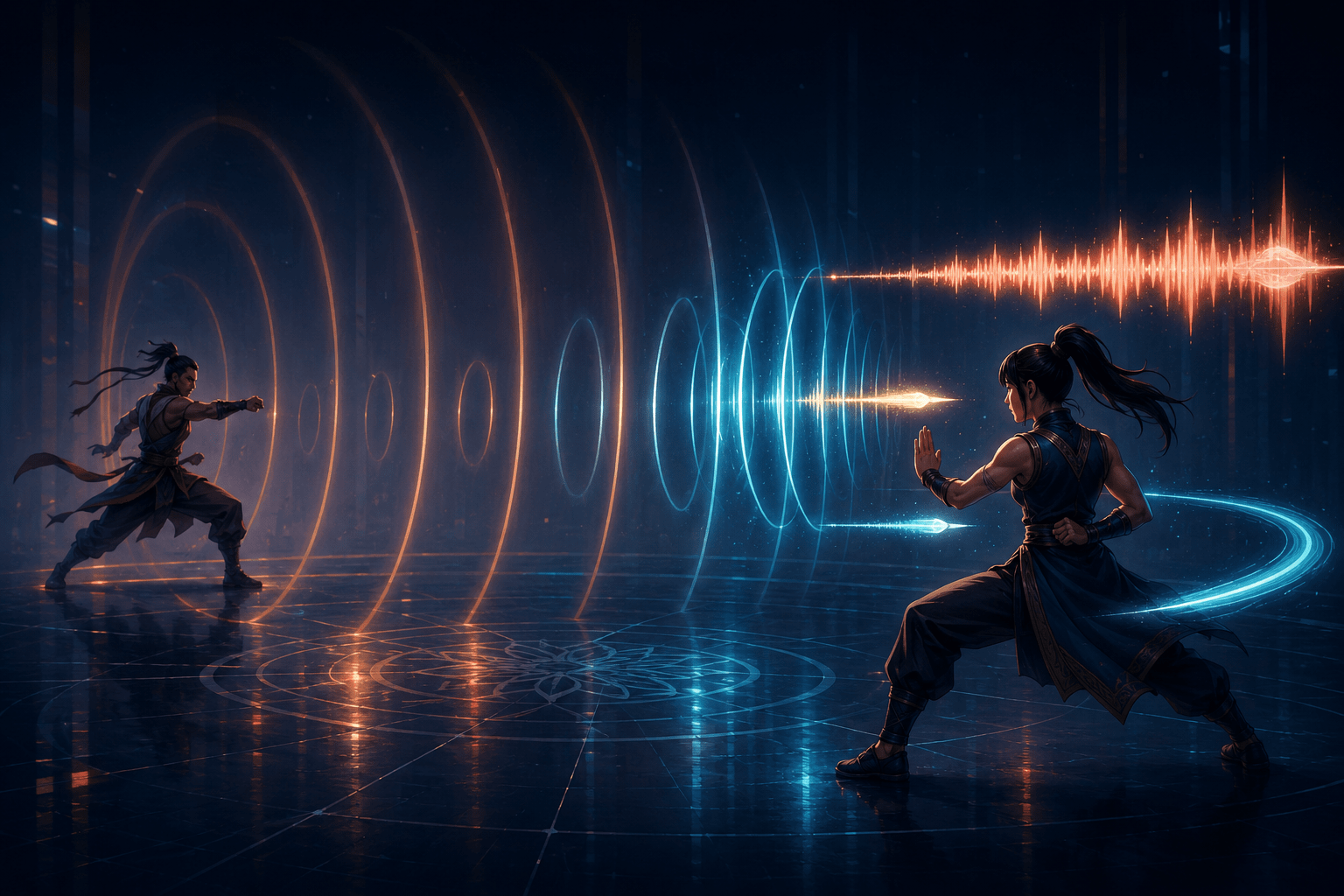
Street Fighter 6 can play a continuing sound that represents the distance between the two fighters. As they move closer together, the cue becomes higher in pitch and repeats more frequently. At greater distances, it becomes lower and the interval between sounds increases. The sound also communicates which side of the opponent the player’s character occupies.
This design converts a continuously changing spatial relationship into a continuously changing auditory one. It is different from a warning that activates only when an opponent enters a fixed area. A player can listen to the gradual changes while walking forward, retreating, jumping, or being pushed backward after an attack.
The pitch and repetition rate provide two related indicators instead of relying on loudness alone. Loudness can be affected by headphones, speakers, individual hearing, and competing game audio. Changes in pitch and rhythm may remain more distinguishable without implying that every player will perceive them equally well.
The cue may support decisions such as whether to attempt a throw, use a long-reaching normal attack, or anticipate an opponent entering striking range. It does not identify the exact numerical distance, name an available move, or confirm that a chosen attack will connect. Character-specific reach, animation timing, movement, and hitbox interactions remain part of learning the game.
Attack-level cues communicate high, middle, and low threats
Fighting-game defence is not a single action. Standing and crouching guards protect against different attack levels, while certain overhead and low attacks are specifically intended to challenge a player’s defensive choice. Visual recognition ordinarily depends heavily on an attack’s pose and animation.
The high, middle, and low attack sounds in Street Fighter 6 supply an additional channel for distinguishing attack levels when attacks connect. These cues can help a player associate an event with its vertical category without relying entirely on the animation or the location of an impact effect.
That distinction matters because a generic hit sound only confirms that contact occurred. It does not necessarily explain what kind of attack caused it. An attack-level cue carries more specific information that may help a player study an opponent’s patterns, understand why a defensive sequence failed, and learn which techniques target different guard positions.
These sounds should not be confused with automatic blocking. They do not move the character, select the correct guard, or remove reaction and prediction requirements. A cue associated with an attack event also does not necessarily offer the same advance notice as clearly seeing an animation begin. The practical value will depend on the move, its speed, when its cue is produced, and the player’s familiarity with the sound vocabulary.
Cross-up sounds address a directional problem
A cross-up occurs when an airborne attack passes over or lands on the opposite side of the defending character. Because blocking normally requires holding away from the attacker, the correct direction can reverse during the jump. Losing track of which side the opponent occupies can therefore cause a block to fail even when the player anticipates an attack.
Street Fighter 6 includes a cross-up attack hit-symbol sound. In combination with the opponent-distance cue’s directional information and the game’s stereo combat audio, it may help make these side changes more recognizable.
The cross-up cue is not route automation or directional correction. It does not turn the character toward the opponent on the player’s behalf, and it cannot guarantee that someone will reverse their input within the available time. Its role is informational: it gives a characteristic event another audible identity.
Headphones or well-separated stereo speakers may make spatial distinctions easier to interpret than a single speaker, but headphones are not comfortable or appropriate for every player. Hearing differences, unilateral hearing loss, auditory-processing demands, and the acoustics of the room may all affect how useful directional sound is.
Gauge information can be requested or signalled
Combat decisions also depend on meters positioned around the battle display. Vitality represents remaining health. The Drive Gauge powers several offensive and defensive systems and can enter Burnout when depleted. The Super Art Gauge determines which Super Arts are available.
The sound accessibility options include notifications for Vitality and Super Art gauge amounts, a Drive Gauge status notification, and an effect indicating Super Art gauge use. Rather than requiring constant visual checks at the edges of the screen, these sounds can expose selected resource information through audio.
The Vitality and Super Art gauge report is requested through an assigned assisting-sound input. This is an important distinction from continuous narration. The player chooses when to obtain the information instead of hearing spoken values repeatedly throughout the match. On-demand reporting can reduce unwanted interruptions, but it also introduces another control to remember and press during play.
Drive status and Super Art usage sounds serve somewhat different purposes. Status notification can make a resource condition noticeable, while a usage indicator confirms an event involving that resource. Neither substitutes for learning what the gauges do. A player still needs to understand Burnout, Drive costs, Super Art levels, and how those systems affect strategy.
Selection narration supports entry into a match
Accessible combat is of limited use if a player cannot choose a fighter or stage. Street Fighter 6 therefore provides narration for stage and character selection, with a choice about when the narration occurs. It can speak while the cursor moves over an option or wait until the player presses a button.
Immediate cursor narration may make exploration faster because each movement produces identifying feedback. Button-press narration may reduce speech overlap or unwanted repetition for a player who moves quickly through a familiar grid. This is a timing preference, not a difference in the information being described.
Selection narration should not be mistaken for comprehensive screen narration. It addresses particular selection interfaces rather than every menu, tutorial, World Tour activity, Battle Hub interaction, notification, or piece of on-screen text. Players may still encounter visually dependent navigation before and after individual fights.
Why separate, configurable cues matter
The system consists of multiple options instead of one all-or-nothing accessibility mode. A player who wants distance information may not need attack-level sounds. Another player may prefer gauge notifications without a continuous spacing cue. Separating the components allows the audio mix to be adapted around an individual’s useful cues and tolerance for additional sound.
This can be particularly important in a fighting game, where attacks, footsteps, voices, music, stage ambience, impact effects, commentary, and system sounds can occur together. Every added cue competes for auditory attention. Turning on all available indicators may provide more data while also making the soundscape harder to parse.
The game’s broader audio controls can be used to rebalance that competition. Reducing music, commentary, crowd, or environmental audio while preserving important combat and accessibility sounds may improve cue separation for some players. Others may use character voices and ordinary attack effects as essential landmarks and should avoid lowering them without testing the result.
There is no universally correct mix. Adjustments are best evaluated in training or low-pressure matches, where each cue can be heard repeatedly and associated with the event it represents. Learning one component at a time may be less demanding than activating the full set immediately.
Sound access is different from simplified controls
Street Fighter 6 also offers Classic, Modern, and Dynamic control types, but these address a different set of barriers. Modern Controls reduce some input complexity. Dynamic Controls select context-sensitive attacks from simplified inputs and are restricted to certain offline play. The sound accessibility cues communicate combat information; they do not simplify the inputs used to respond to it.
A player may combine sound cues with Classic or Modern Controls according to their needs and the mode’s rules. Someone who can execute traditional motions but cannot reliably read the battle visually may use Classic Controls with extensive sound feedback. Someone facing both visual-information and motor-input barriers may combine the cues with Modern Controls.
Neither combination guarantees access. Remapping or simplifying commands is not the same as supporting a particular physical controller, switch interface, or alternative-input device. Hardware compatibility and platform-level remapping remain separate considerations.
Training remains necessary
The sounds form a vocabulary. At first, a change in pitch or a brief attack symbol may not have an obvious meaning. Players may need time to learn which sounds represent close range, a low attack, a gauge condition, or a side change.
Training mode can help isolate those relationships. Repeating movement at different ranges can demonstrate the distance pattern. Recorded opponent actions can make attack-level and cross-up cues easier to compare. Gauge settings can create repeatable resource states. This is learning support rather than automatic completion: practice is still required to connect each signal with a useful decision.
The system was developed with direct input from ePARA, a Japanese barrier-free esports organization. According to ePARA’s account of its work with Capcom, three totally blind participants tested the game’s sound accessibility, and the organization supplied advisory reports led by disabled participants. That involvement gives the feature an important basis in user testing, but it does not mean every blind or low-vision player will have the same experience.
Meaningful limitations remain outside the fight
The strongest coverage is concentrated in structured one-on-one combat and selected setup screens. Street Fighter 6 also contains World Tour, an explorable single-player mode, and Battle Hub, a shared three-dimensional social space. Moving through these environments introduces navigation, object-location, text, camera, and interaction demands that the battle sounds do not resolve.
The cues also do not describe every animation, tactical state, menu, tutorial diagram, cosmetic element, or online communication. They cannot replace the need for accessible documentation, learnable controls, or assistance with visually dependent areas. A player may be able to conduct a match through sound while still requiring support to reach that match or configure some options.
Audio density is another practical limitation. Fast exchanges can produce numerous effects in a short period, especially when both fighters use resource-heavy attacks. Additional accessibility signals may be masked or cognitively demanding. Players with hearing loss affecting particular frequencies may not perceive every cue reliably, while players sensitive to repetitive or high-frequency sound may find some configurations uncomfortable.
The system is included in current editions of Street Fighter 6 for PlayStation 4, PlayStation 5, Xbox Series X|S, Steam, and Nintendo Switch 2. Audio reproduction will vary among televisions, handheld speakers, headphones, external sound systems, and platform audio settings. A configuration learned on one setup may require adjustment on another.
Street Fighter 6 demonstrates how distance, attack categories, direction changes, and resource states can be represented through purpose-built sound rather than louder effects alone. These cues may make individual fights substantially more legible, but access needs vary, the sounds require interpretation and practice, and they do not provide complete nonvisual access to every mode or interface surrounding combat.