
Colour can serve several different purposes in a game. It may establish mood, separate a character from the background, or simply decorate an environment. In other situations, colour communicates a rule the player must understand immediately. That last use can create a barrier when the information is available through colour alone.
Undertale uses colour as part of its mechanical vocabulary. During certain encounters, the colour of an attack can indicate how the player should respond. Elsewhere, coloured switches and coloured monster names communicate distinctions that may be relevant to a puzzle or battle. Recognizing that something has changed is not necessarily enough: the player may need to identify the particular colour and remember the rule attached to it.
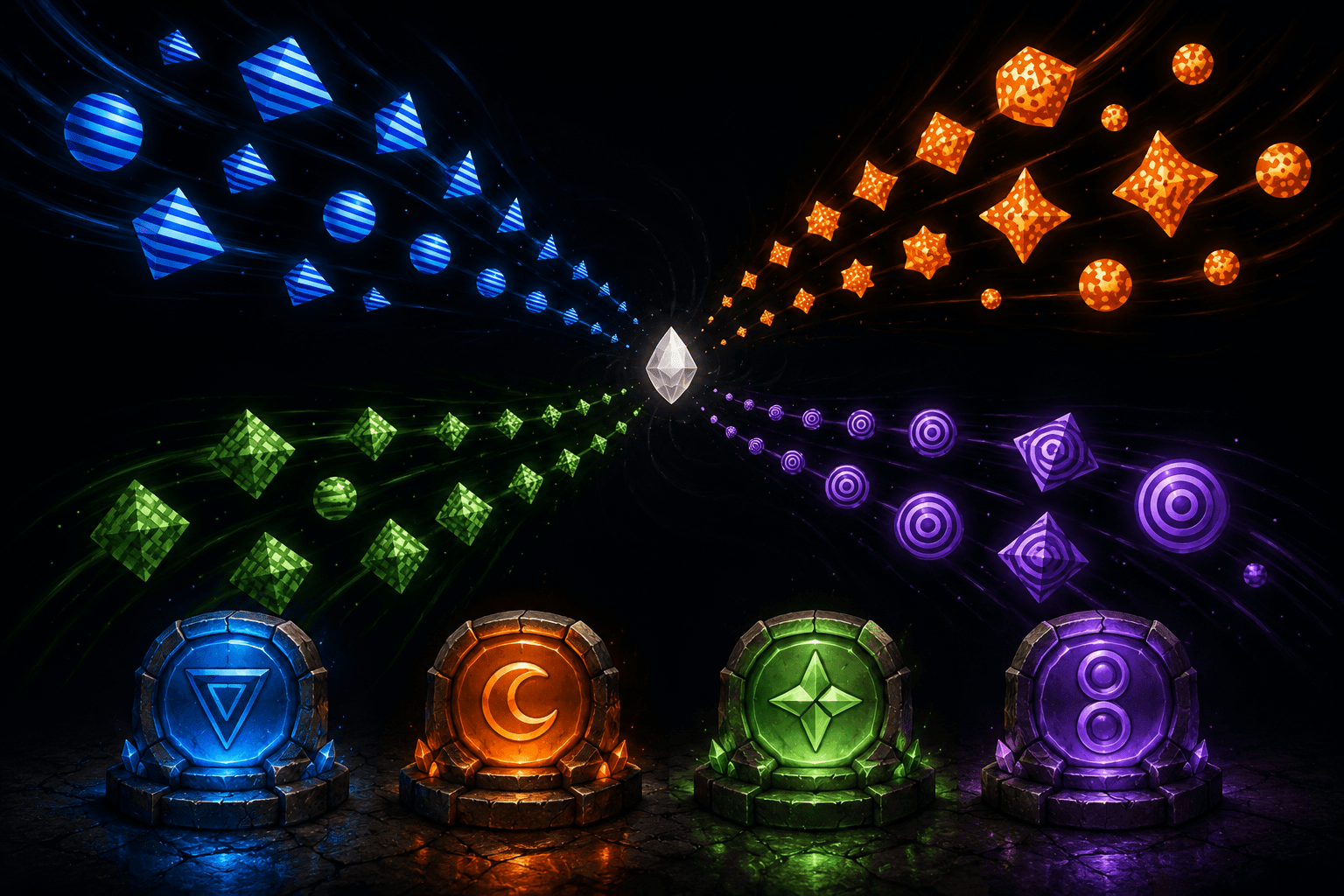
Colorblind Accessible Undertale is a third-party mod by KaiSchlabitz that addresses selected examples of this colour-only communication. Rather than applying a general colour filter, it adds patterns to attacks, symbols to coloured switches, and short indicators beside monster names whose colour conveys information. The objective is to create redundant visual cues so that the relevant categories can remain distinguishable even when their colours are not.
Adding another channel without removing colour
The mod’s central design choice is redundancy. It does not attempt to find a replacement palette that every player will perceive identically. It retains the existing colours while placing another visual property alongside them.
For attacks, that additional property is a pattern. Attacks differentiated by colour receive different surface treatments so that their categories can also be recognized through markings. A player who cannot reliably separate the original colours may therefore be able to associate a stripe, texture, or other pattern with the corresponding response rule.
This differs from recolouring. A recolouring mod substitutes one set of colours for another, usually aiming for combinations that are easier to distinguish for a particular form of colour-vision deficiency. That approach can be useful, but it still asks colour to carry the information. It may also produce different results for different displays, lighting conditions, colour-vision profiles, or capture devices.
Pattern differentiation changes the structure of the communication. Even if two colours appear similar, the objects can remain visually distinct because their markings differ. Players who perceive the colours clearly can continue to use them, while players who do not can attend to the patterns. Some players may use both channels together.
The mod is described by its creator as being intended to support people with monochromacy or total colour blindness. Its redundant cues may also be useful in other circumstances where the original colours are difficult to separate, but that should not be treated as a universal result. Pattern visibility, visual acuity, contrast sensitivity, display size, and the speed of an encounter can all affect whether the added information is practically usable.
Patterns communicate the attack category, not the response itself
Adding a pattern does not automate combat. It gives the player another way to identify an attack category, but the player must still know what that category means, recognize it during play, and perform the appropriate movement at the required time.
This distinction matters because recognizing an attack and avoiding it are separate demands. The mod may reduce dependence on colour discrimination, but it does not remove reaction timing, spatial tracking, precision movement, divided attention, or the need to learn encounter rules. A player who can identify the new pattern but cannot execute the required response may still encounter the same motor or timing barrier.
The modification is therefore closer to accessible labeling than combat assistance. It changes how information is presented without completing the associated action. It also does not appear to add an audio or tactile representation of the patterns. The relevant distinction remains visual, which limits its usefulness for players who cannot obtain enough information from the screen.
Symbols make coloured switches independently identifiable
Colorblind Accessible Undertale also adds symbols to coloured switches in a puzzle. This applies the same redundant-coding principle to a different interaction. Instead of requiring the player to identify a switch only as a particular colour, the game can present it as a colour-and-symbol combination.
Unique symbols can support both immediate recognition and memory. A player may be able to remember a shape or mark more reliably than an uncertain colour description. The symbols can also make it easier to compare a switch with earlier information without mentally translating two colours that appear nearly identical.
The symbols do not solve the puzzle. They distinguish the switches, but the player must still determine which one is relevant, understand any instructions or environmental clues, remember the required relationship, and carry out the interaction. This is the difference between navigation or identification support and automatic completion.
Because the original colour remains visible, the modification also avoids unnecessarily taking information away from players who use it. The resulting cue has two components: colour for players who can distinguish it and a symbol for players who need or prefer another identifying property.
Battle-name indicators replace another colour-only distinction
In addition to attacks and switches, the mod adds “(Y)” or “(p)” indicators to battle monster names that are displayed in colour to communicate a state. This converts a formatting change into an explicit character-based marker.
A coloured name can be difficult to interpret when the surrounding text has similar brightness or when the hue distinction is unavailable to the player. A nearby indicator makes the change detectable without relying entirely on that hue. Unlike a screen-wide filter, it can also clarify which interface element carries the relevant information.
The indicators are compact, but compactness has trade-offs. A player must notice the extra characters and learn what they represent. The mod page documents their presence, but they should not be mistaken for a full plain-language explanation of every battle state. They supply an alternative marker for the original colour distinction rather than rewriting the interface or tutorial system.
Why a general colour filter is not equivalent
Operating systems, displays, graphics drivers, and some games can apply colour filters intended to separate selected hues. Those filters transform the rendered image globally. They may improve contrast between particular colours, but they do not know why the developer used a colour or which differences are mechanically important.
Colorblind Accessible Undertale instead changes particular objects whose colour communicates gameplay information. Its patterns and symbols remain attached to the attacks, switches, and names that need to be distinguished. This targeted approach avoids depending entirely on a different palette and may make the intended categories more explicit.
The two approaches are not necessarily mutually exclusive. A player could potentially use a display-level filter for general visibility while using the mod’s patterns for mechanically significant distinctions. However, combining visual transformations can have unintended effects. A filter might reduce the contrast between a pattern and its background, while scaling or post-processing may make small markings harder to resolve. The combined result needs to be assessed in the actual game rather than assumed to be better.
Visual redundancy can introduce visual density
Patterns add information, and additional information can also add complexity. In a fast encounter containing several moving objects, surface markings may create more visual detail to process. Players who are sensitive to dense textures or who have difficulty separating rapidly moving patterns may not find every treatment easier to follow.
The practical value of a pattern also depends on its size and contrast. A pattern that is clear in a still image can become less distinct when the object is small, moving quickly, overlapping another effect, or shown on a low-resolution display. The mod’s version history illustrates the importance of implementation details: version 2 corrected sprite padding and bounding-box issues and addressed an asterisk that flashed red, blue, and green in the colour-switch room.
Those corrections show that accessibility coverage is not achieved simply by defining a design principle. Each relevant asset and interaction must be identified, modified, and tested. The creator invites users to report missed elements or problems, so the mod should be understood as a maintained intervention rather than a guarantee that every colour-dependent detail has been eliminated.
Installation and platform limitations
Colorblind Accessible Undertale is not a setting built into Undertale. It requires GMLoader and can be installed using Vortex Mod Manager or Mod Loader 2 before GMLoader is run. This introduces setup steps that do not exist for a native accessibility option.
Players must be able to obtain the necessary files, use a compatible mod-loading workflow, and troubleshoot potential conflicts or changes. Game updates, loader updates, or other mods may affect compatibility. The original mod page should be consulted before installation because its requirements and instructions can change.
This installation method also means the feature should not be presented as a general console option. It is a PC mod dependent on external loading tools, not a cross-platform accessibility setting supplied through the game’s normal menus. Players using a console or another environment that cannot run the required loader do not receive the same access.
Third-party status affects support as well. The mod is released under the permissive 0BSD licence, but responsibility for maintaining it remains separate from the game’s official development and support channels. A native implementation would have advantages in discoverability, testing, platform coverage, and resilience across updates.
Combining the mod with other forms of access
The mod can address colour-dependent recognition while leaving many other demands unchanged. A player may still need options outside the mod for display scaling, contrast, input remapping, timing, flashing effects, audio presentation, or text readability. Improving one information channel does not make the complete game accessible across unrelated barriers.
When evaluating the mod, it can help to separate three questions: whether the modified element can be detected, whether its category can be identified, and whether the player can act on that information. Patterns and symbols primarily address the second question. They may also improve detection when they create stronger visual contrast, but they do not necessarily change the action required afterward.
The creator’s Colorblind Accessible Undertale page on Nexus Mods provides the current download, dependency information, installation steps, permissions, update history, and a place to report problems. Checking that page is particularly important because the mod relies on third-party tools rather than an official in-game option.
A focused alternative to colour-only rules
Colorblind Accessible Undertale demonstrates a practical difference between changing colours and changing how information is encoded. By supplementing colour-coded attacks with patterns, switches with symbols, and coloured battle names with character indicators, it makes selected distinctions available through more than hue alone.
Its scope remains specific. It does not automate encounters, remove timing or movement demands, provide a nonvisual equivalent, or guarantee that every pattern will be equally readable for every player. Access needs and visual perception vary, and the mod’s practical benefit depends on whether its added markings remain visible and understandable in the situations where the player needs them.