
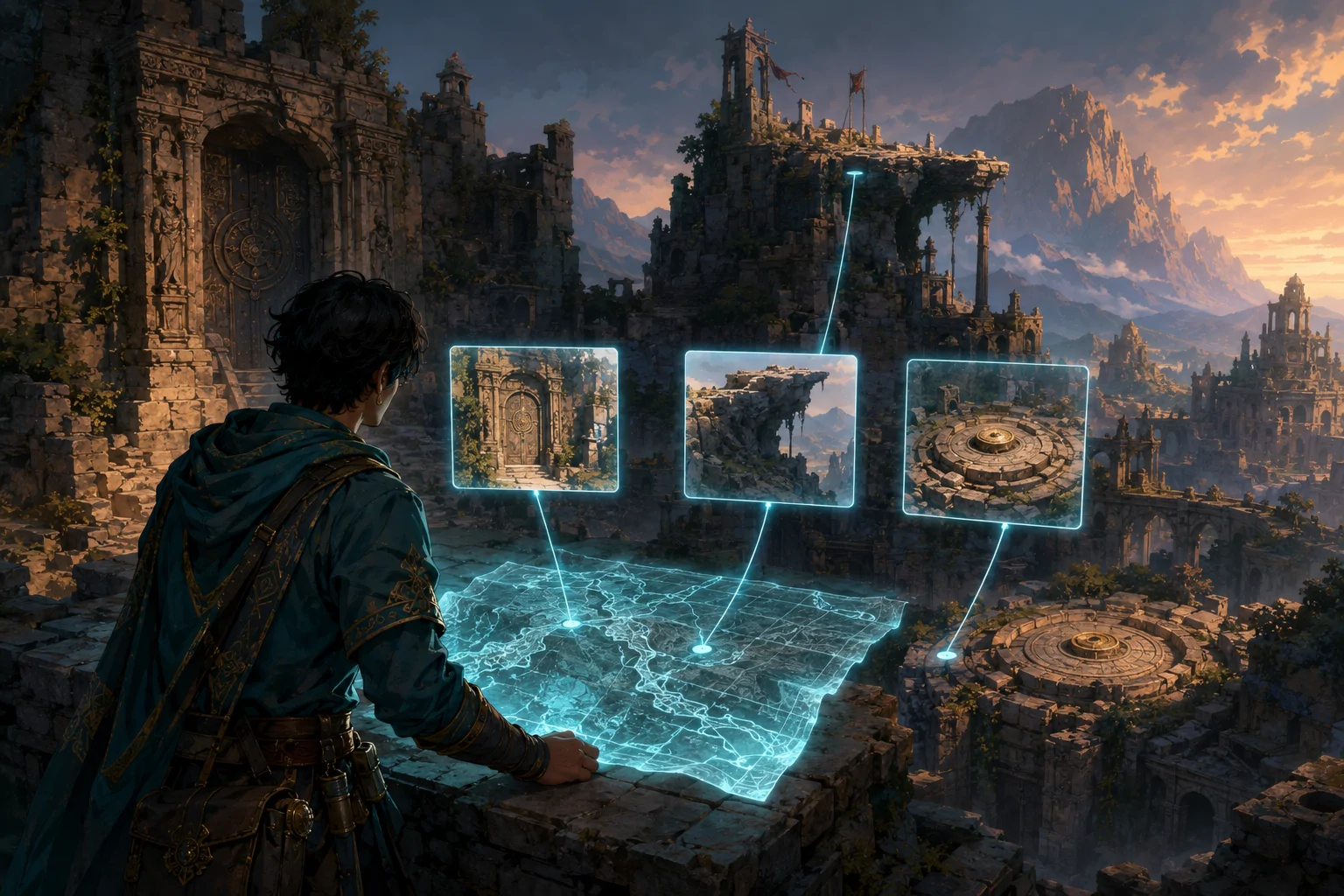
Exploration games often expect players to remember far more than the locations shown on their maps. A blocked passage may require an ability that will not be acquired for several hours. An inaccessible chest might sit above an unfamiliar platforming sequence. A suspicious wall may look important even though the player cannot yet interact with it. When the necessary ability finally becomes available, the player must remember not only where the obstacle was, but also what it looked like and why it seemed relevant.
Prince of Persia: The Lost Crown addresses this cognitive demand through Eye of the Wanderer, an in-game system that allows players to capture an image of their current surroundings and attach it to the corresponding location on the map. These saved images are called Memory Shards.
The feature does not solve puzzles, identify the ability needed to pass an obstacle, or automatically direct the player back to it. Instead, it lets the player create a visual reminder using information they personally considered important. This makes Eye of the Wanderer an unusually direct example of a game externalizing part of the memory work normally placed on the player.
How Eye of the Wanderer Works
When a player encounters a location they want to remember, they can use Eye of the Wanderer to capture a screenshot of the immediate scene. The resulting Memory Shard is pinned to the map at the location where it was created. When the player later examines that map marker, they can see the saved image rather than relying on a generic symbol or an unaided recollection of the area.
This matters because a conventional map marker usually records only position. It may tell the player that something was noticed in a particular room, but not what that something was. A screenshot can preserve the appearance of a blocked doorway, an unreachable ledge, a chest behind an environmental obstacle, or a platforming route that could not yet be completed.
The player decides what is worth recording. Eye of the Wanderer does not automatically classify the obstacle or attach an objective description. This gives the system considerable flexibility: two players can visit the same location and save different details based on what each wants to revisit.
The feature is automatically enabled rather than hidden behind an accessibility menu. It functions as part of the game’s ordinary exploration design, although its practical value may be especially significant for players who experience difficulties with working memory, prospective memory, spatial recall, task resumption, or maintaining a mental list of unfinished locations.
Replacing Mental Notes with Visual References
Games built around nonlinear exploration frequently use ability-gated progression. Players see paths they cannot currently cross and return after acquiring new movement or interaction powers. This structure creates an ongoing collection of deferred intentions: remember the sealed door, return to the high platform, investigate the strange mechanism, or check whether a new power works on an earlier obstacle.
Remembering to perform an intended action later is associated with prospective memory. The player must retain the intention while completing unrelated combat, dialogue, puzzles, and exploration. Even if the intention is remembered, the player may no longer recall the precise location or visual characteristics of the obstacle.
Eye of the Wanderer transfers part of that burden from internal recall to external recognition. Instead of reconstructing the scene from memory, the player can recognize it from the stored image. Recognition can be easier than recalling an unrecorded location without a visual prompt, although individual experiences will vary.
The feature may also support task resumption after time away from the game. A player returning after several days or weeks can inspect saved images to recover some of the context surrounding earlier discoveries. A generic map marker might reveal that the player placed a note there, while a Memory Shard can show what originally prompted the note.
This does not create a complete activity history. It records only the places the player deliberately captures, and an image may not explain why it was saved if its subject is ambiguous. Its effectiveness therefore depends partly on when and how consistently the player uses it.
A Memory Aid, Not Route Automation
Eye of the Wanderer should be distinguished from automatic navigation. It does not move the character, calculate a route, provide turn-by-turn directions, or guarantee that the player can find the correct path back to a saved location. It preserves a memory at a location; it does not complete the return journey.
This distinction is important because remembering a destination and navigating to it are separate demands. A player may know exactly which obstacle they want to revisit but still have difficulty interpreting the map, recognizing connecting passages, or determining which route is currently open.
The screenshot also does not identify the solution. A saved image of a blocked passage may remind the player that the passage exists, but the player must still determine whether a newly acquired power applies there. Eye of the Wanderer assists with retaining information without automating the reasoning or exploration built around that information.
That balance may appeal to players who want support for memory demands while preserving the investigative structure of the game. However, it also means the feature will not be sufficient for everyone who experiences navigation barriers.
How It Differs from Guided Mode
Prince of Persia: The Lost Crown also provides an optional Guided Mode. Ubisoft describes this mode as adding icons for objectives and for available or blocked paths. Although Guided Mode and Eye of the Wanderer both concern navigation, they provide different kinds of assistance.
Guided Mode supplies information selected by the game. Its icons clarify parts of the intended progression structure and can reduce uncertainty about where paths or objectives are located. Eye of the Wanderer records information selected by the player. It can preserve anything the player considers noteworthy, including optional discoveries that may not be represented by objective guidance.
Guided Mode therefore provides structured navigation information, while Eye of the Wanderer functions more like a personalized visual notebook. One is not simply a stronger version of the other. A player might understand the game’s objective markers but still forget why a particular optional room mattered. Conversely, a player might remember saved obstacles clearly but need additional help finding a viable route through the interconnected environment.
The two systems can be used together. Guided Mode can provide broader information about objectives and paths, while Memory Shards preserve the visual context of discoveries the player wants to revisit. Combining them may reduce both route-finding uncertainty and the burden of remembering deferred tasks.
Why Screenshots Communicate More Than Standard Map Symbols
A map can become difficult to interpret when many identical custom markers accumulate. If every marker uses the same symbol, the player may need to remember whether each one represents an inaccessible chest, a puzzle, a blocked route, or something else. Providing several marker types can help, but the player must still learn and remember the meaning of those symbols.
A visual memory retains details that are difficult to compress into a single icon. The shape of an obstruction, the position of nearby platforms, the colour of an environmental element, and the object visible beyond the barrier can all remain available in the captured scene.
This can reduce the need to translate an experience into a label at the moment it occurs. The player does not have to decide whether an unusual structure belongs under “puzzle,” “door,” “collectible,” or another predefined category. They can save what they saw and interpret it later.
At the same time, a screenshot is not inherently clearer than a symbol. Visually dense scenes may contain several possible points of interest. If the relevant object occupies only a small part of the frame, the player may have difficulty identifying it later. Because the feature stores an image rather than a written note, it does not let the player explicitly record an instruction such as “return after obtaining the double jump.”
Combining Memory Shards with Other Accessibility Settings
Eye of the Wanderer addresses only one part of a larger interaction. Players must first perceive the environment, decide that a location is important, capture it, locate its marker later, understand the saved image, and navigate back to the area. Other settings can support different stages of that process.
Guided Mode can add path and objective information. Interactive-element highlighting can make relevant objects more visually distinct. The game’s high-contrast settings can remove colour from the background, apply bright colours to important gameplay elements, or combine those changes. An adjustable HUD size can affect the visibility of interface elements, while reminders for important controls may reduce the need to recall an input after time away.
Screen shake can also be disabled. This does not alter the information stored in a Memory Shard, but it may reduce an unrelated visual or vestibular barrier during exploration and combat. Players who find several simultaneous effects overwhelming can therefore adjust parts of the presentation while continuing to use the map-memory system.
These settings are complementary rather than interchangeable. High contrast changes visual separation. Guided Mode adds developer-defined navigation information. Control reminders support input recall. Eye of the Wanderer preserves player-selected environmental context. Combining them can address more than one barrier without suggesting that a single preset will suit every player.
Limitations and Remaining Barriers
Eye of the Wanderer is fundamentally visual. A screenshot-based reminder may be inaccessible to a player who cannot perceive or interpret the saved scene. Ubisoft’s documented feature list does not describe Eye of the Wanderer as providing a spoken description, custom text annotation, or comprehensive screen-reader alternative for these visual memories.
The map itself remains part of the interaction. Players who find spatial maps confusing may still struggle to understand how a saved location relates to their current position. The feature identifies where a memory was created, but it does not remove the need to navigate the game’s interconnected areas.
Using the system also requires prospective action at the original location. The player must recognize that something may matter later and remember to capture it before moving on. Obstacles that were not recorded receive no retrospective screenshot automatically.
Memory Shards can reduce the need to hold unfinished locations in memory, but they do not organize an entire return journey or determine which saved locations have become accessible after a new ability is acquired. Players may still need to review their memories, compare them with their current powers, and decide where to go next.
There is also a potential information-management cost. If many visually similar locations are saved, reviewing them may become its own cognitive task. Clear, selective captures may be more useful than recording every uncertain object, but the appropriate amount of information will depend on the player.
Availability and Practical Scope
Eye of the Wanderer is a built-in part of Prince of Persia: The Lost Crown, not a third-party modification. Ubisoft lists the game on PC, Nintendo Switch, PlayStation 4, PlayStation 5, Xbox One, Xbox Series X|S, and Amazon Luna. The publisher’s official Eye of the Wanderer guide specifically describes using screenshots and Memory Shards to remember chests, blocked routes, and platforming paths that may become reachable after obtaining additional powers.
The feature is notable because it supports exploration without converting exploration into automatic completion. It preserves player-chosen visual context and ties that context to place, reducing some of the memory demands created by delayed, ability-gated progression.
Access needs vary, and a visual map memory cannot replace readable navigation, accessible controls, nonvisual information, or route assistance where those are required. Eye of the Wanderer may make deferred discoveries easier to remember, but players must still capture, interpret, and independently return to those locations.