
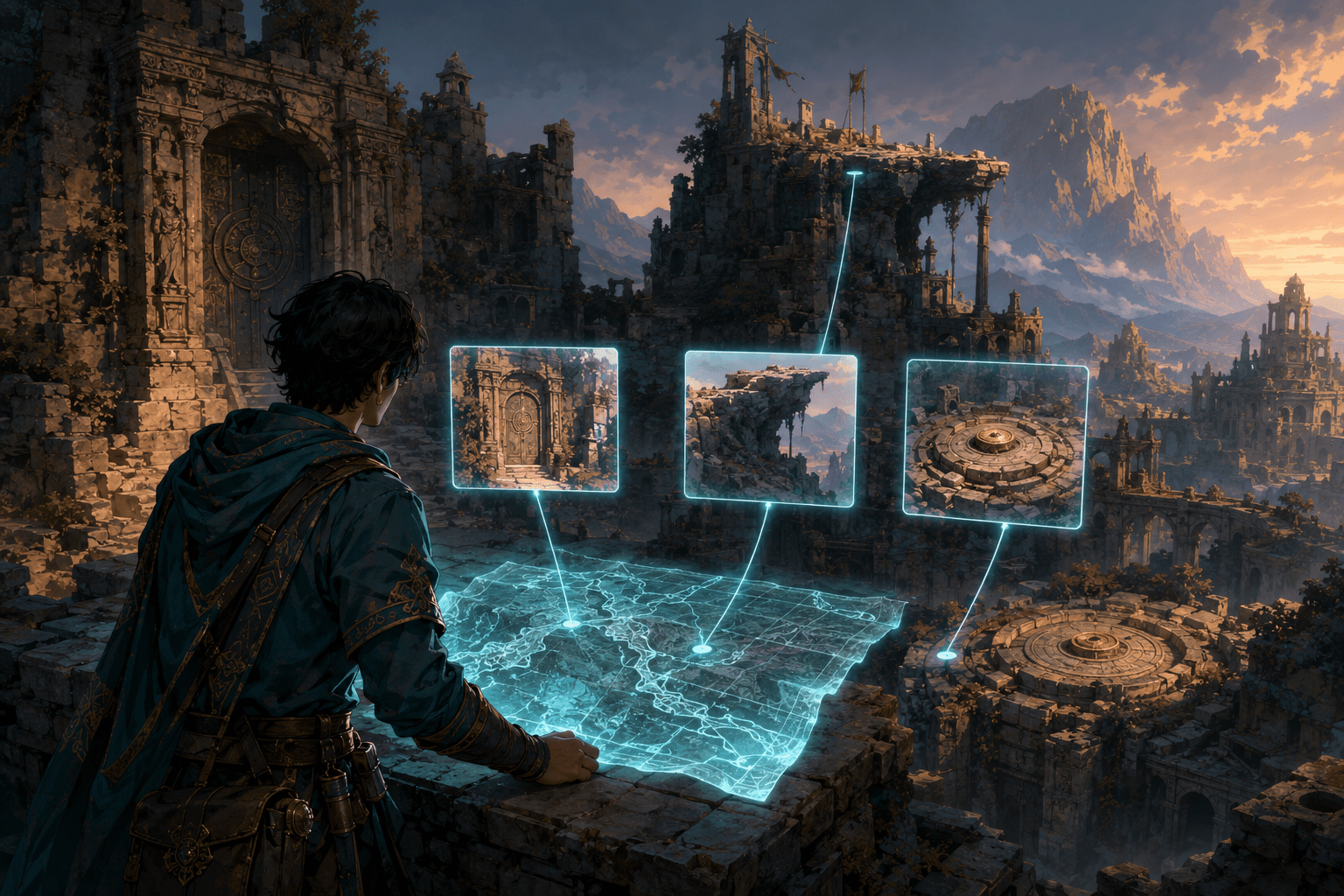
Prince of Persia: The Lost Crown includes Eye of the Wanderer, which allows players to capture a screenshot of their current location and pin the image directly to the map.
This can reduce the need to remember where an inaccessible route, unusual mechanism, unopened passage, or ability-dependent obstacle was located. The feature preserves visual context but does not determine how to overcome the obstacle.
Remembering Inaccessible Routes
Exploration games often introduce routes before the player has the required movement ability or power. A conventional marker can show that something is important without explaining what the player saw there.
A Memory Shard can preserve the visible obstacle itself: a sealed gate, unreachable ledge, blocked tunnel, unusual wall, or inactive mechanism. After obtaining a new ability, the player can review those images to identify places worth revisiting.
Externalizing Mental Notes
Remembering an obstacle can involve what it looked like, where it was, which direction the player approached from, and why progress stopped. Large maps, similar-looking areas, interruptions, and long gaps between sessions can add to that demand.
Pinning a screenshot to the location externalizes the information. The player does not need a separate written list or a memory of what each generic symbol meant.
Visual Context and Limits
A screenshot can retain environmental details that are difficult to express in a short label. This may help players who find visual recognition easier than recalling written notes and avoids the input demands of typing a custom description.
The system remains visually based. It does not narrate or classify the image, and a player must recognize that the location is worth recording. Memory Shard capacity is finite, although more can be obtained.
Guided Mode
Guided Mode adds icons for main objectives and shows available or blocked paths. It supplies broader navigational structure, while Eye of the Wanderer preserves player-selected visual detail.
Neither system creates a continuously automated route through every room. Players still interpret local geometry and complete required combat, puzzle, or traversal actions.
Platforming and Visual Assistance
Designated platforming sections can include an optional portal that bypasses the challenge. High Contrast settings can remove colour from the background and apply bright colours to important gameplay elements.
These address separate barriers: the Memory Shard helps the player remember where to return, the portal can bypass selected execution demands, and High Contrast can make relevant elements easier to distinguish.
Dialogue and Control Reminders
Important control reminders can reduce the need to recall an input after a break. A text log preserves the last 50 lines of conversation for review. These systems complement map memories but do not form a complete searchable record.
Last verified: August 3, 2026.
Access needs vary. Review the official accessibility documentation for the complete settings and current platform details.