
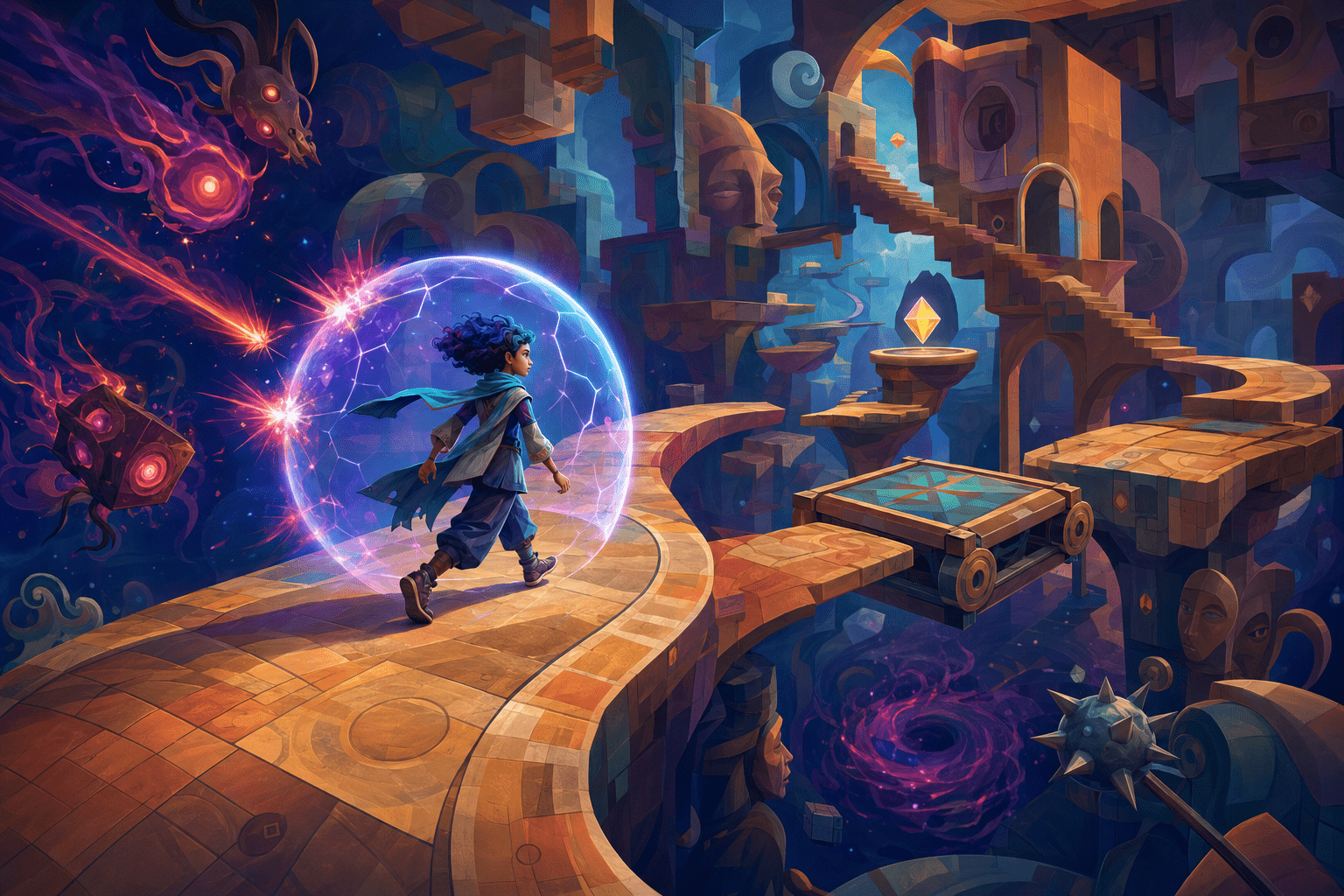
Psychonauts 2 includes an optional Invincibility assist that prevents Raz from taking damage from most attacks. It can reduce the consequences of being hit without automatically completing combat, removing enemies, navigating levels, or performing platforming actions.
The wording “most attacks” is important. Double Fine does not describe the setting as universal immunity to every possible hazard or failure condition. The game also provides separate options for No Fall Damage and Narrative Combat, showing that attack damage, missed jumps, and the amount of damage Raz inflicts are treated as different parts of the experience.
Invincibility may support players who can participate in combat but cannot consistently avoid every attack, manage multiple threats, or recover from repeated damage. It can also reduce pressure for players who want to explore the game’s environments and story without losing progress because of most enemy attacks.
The feature is assistance rather than automatic completion. The player continues controlling Raz and deciding how to approach the game.
What Invincibility Changes
Double Fine’s official description states that when Invincibility is enabled, Raz will not take damage from most attacks. This changes the consequence of being hit by supported attacks.
Under ordinary conditions, an attack reduces health. Repeated attacks can eventually cause failure and require the player to resume from the game’s recovery point. Invincibility interrupts much of that damage cycle.
The enemy can still attack. The player can still be struck. Attack animations, visual effects, sounds, interruptions, and the presence of hostile characters remain part of the scene. What changes is the health damage produced by most attacks.
This distinction matters because being hit and being damaged are not identical events. A player may still experience visual impact effects or lose their immediate position even if health is preserved. Invincibility should not be described as removing every effect associated with enemy contact.
The official wording also does not promise immunity from every source of damage. “Most attacks” indicates broad protection while leaving unspecified exceptions. Players should not assume that every environmental hazard, scripted event, fall, or unusual mechanic is covered.
Invincibility Is Not Enemy Removal
An enemy-removal setting would prevent hostile characters from appearing or convert them into non-hostile entities. Invincibility does not do that.
Enemies remain in the level and continue their behaviour. The player may still need to engage with them to open a path, complete an objective, protect another character, or continue the sequence.
The setting therefore preserves the structure of combat while changing much of its punishment. Players can still use Raz’s psychic abilities, experiment with powers, target enemies, dodge, and learn attack patterns.
A player may choose to avoid attacks even when damage is disabled. The setting does not force one play style or prevent someone from treating combat as a conventional challenge.
Because enemies remain active, Invincibility may not eliminate barriers related to their appearance, motion, sounds, screen effects, crowding, or ability to interrupt the character. It changes damage rather than the complete sensory and mechanical presentation of combat.
Invincibility Is Not Automatic Combat
Automatic combat would select targets, activate powers, attack enemies, and complete encounters without the player’s input. Invincibility performs none of those functions.
The player still chooses where to move, which enemy to target, and which abilities to use. If progression requires defeating an enemy, preventing damage does not independently defeat it.
This leaves offensive timing and control demands in place. A player who cannot comfortably aim, select powers, press attack inputs, or track the current target may need other settings in addition to Invincibility.
The game includes input options such as lock-on configuration and a radial power menu, but those are separate systems. Invincibility does not automatically activate them or replace their functions.
The feature can reduce the penalty for taking time. A player may have more opportunity to reposition, locate a target, or remember a control when most enemy attacks cannot reduce health. However, reduced punishment is not the same as removal of the original action.
How It Differs from Narrative Combat
Narrative Combat is a separate assist feature that causes Raz to deal more damage. It changes the player’s offensive effectiveness.
Invincibility changes incoming damage from most attacks. Narrative Combat changes outgoing damage. One makes it harder for supported attacks to defeat Raz; the other helps Raz defeat enemies more quickly.
A player may use either option independently. Someone might want ordinary enemy health and a longer opportunity to practise combat without losing health. Another player might accept the risk of damage but want encounters to end with fewer successful attacks.
Using both can reduce two different combat demands. Invincibility can reduce the consequences of errors, while Narrative Combat can shorten encounters and reduce the number of offensive actions required.
Shorter combat may also reduce fatigue, repetition, visual load, or the time spent processing several simultaneous enemies. Invincibility alone does not shorten an encounter if the player still needs the same amount of time and damage to defeat each enemy.
How It Differs from No Fall Damage
No Fall Damage prevents damage when the player misses jumps. Double Fine lists it separately from Invincibility.
This separation indicates that platforming falls are not simply treated as ordinary enemy attacks covered by the Invincibility option. A player who wants protection from both combat damage and missed jumps may need to enable both settings.
No Fall Damage does not automatically land Raz on the correct platform. The player can still miss the intended destination and may need to repeat part of the route.
It also does not create bridges, widen platforms, stop moving objects, or perform jumps. It changes the damage consequence of a missed jump rather than completing the traversal challenge.
The same assistance-versus-automation distinction applies to Invincibility. Both settings protect against certain consequences while leaving the corresponding activity under player control.
Failure Reduction Versus Failure Removal
Invincibility can remove many failures caused by accumulated attack damage. It should not be described as removing every way to fail or become unable to progress.
A player may still be unable to reach a platform, locate an objective, solve a puzzle, execute a required sequence, or defeat an enemy. The setting does not provide route automation or puzzle solutions.
Some gameplay situations may also involve objectives beyond Raz’s health. Invincibility does not guarantee success in any sequence whose completion depends on another condition.
This makes the feature more targeted than a universal “cannot fail” mode. The player gains protection within supported combat situations while the rest of the game’s systems remain active.
The practical effect can still be substantial. In an action-platformer, repeated loss of health can interrupt exploration and prevent a player from reaching later content. Reducing that consequence can provide room to engage with the game on different terms.
Using Invincibility as a Practice Tool
A player can use Invincibility while learning enemy patterns, power combinations, camera control, or target selection. Because most attacks do not reduce health, mistakes may be less likely to end the encounter before the player understands what happened.
This differs from a separate practice arena. The player is still in the normal level, facing the actual enemies and environmental layout present in the game.
The setting may support learning through repetition without forcing a restart after accumulated damage. A player can observe an enemy’s timing or test a newly assigned input with less pressure.
Invincibility does not explain the mechanic. Tutorials, control references, and player observation remain important. Preventing damage can create time to learn, but it does not provide additional instructions by itself.
Some players may keep the setting enabled throughout the game. Others may use it temporarily for a particular encounter or while learning. An accessibility option does not need to function only as training before the player returns to the original damage rules.
Potential Motor-Accessibility Uses
Combat often requires several actions in close succession: moving, controlling the camera, targeting, selecting powers, attacking, and avoiding incoming threats. A player who can perform these actions more slowly may be hit before completing their intended response.
Invincibility can reduce the health penalty associated with that additional time. It does not require the player to suddenly execute a faster dodge simply because an enemy has begun an attack.
The feature may also reduce repeated sequences. If the player no longer loses health from most attacks, they may be less likely to replay an entire combat encounter because one input was late or difficult to reach.
It does not directly change button placement, hold duration, stick sensitivity, or the physical force needed to operate a controller. Those are input characteristics rather than damage consequences.
Psychonauts 2 includes basic input remapping, vibration adjustment, camera inversion, configurable lock-on behaviour, and a radial power-menu option. Combining those controls with Invincibility may address more than one motor barrier.
Potential Cognitive and Attention Support
Combat can create simultaneous demands. The player may need to recognize the enemy type, remember which power applies, monitor health, select a target, follow movement, and respond to attacks.
Removing damage from most attacks can reduce the urgency attached to some of those tasks. A player may have more time to recall a control or determine which threat to address first.
The setting does not reduce the number of enemies, simplify the visual scene, or automatically prioritize targets. It changes the consequence of being hit rather than the amount of information presented.
For some players, knowing that health is protected may reduce pressure enough to make the remaining information manageable. For others, active enemies and repeated impact effects may remain overwhelming even without damage.
Narrative Combat may complement Invincibility by shortening encounters. Shorter exposure and lower consequences are different forms of assistance and may affect cognitive load differently.
What Remains of the Combat Experience
With Invincibility enabled, combat is not converted into a cinematic. The player still engages through movement and psychic powers.
Enemies can remain visually and audibly active. The player can still choose tactics, test power combinations, and search the environment during an encounter. The game does not impose one correct way to use the assist.
The presence of protection may change the emotional experience of combat. Threats may feel less urgent when most attacks cannot reduce health. That is an expected trade-off rather than evidence that the setting is malfunctioning.
Challenge is not a single fixed property. One player may define it through avoiding damage, another through completing the required inputs, and another through navigating a visually complex environment. Invincibility modifies one layer while leaving others intact.
Combining Invincibility with Platforming Controls
Double Fine includes options intended to simplify particular movement combinations. “Use Triple Jump to Glide” allows Raz to begin gliding with one button press instead of a multi-button sequence.
“Levitation Ball Pull-Down from Glide” allows the player to land on the levitation ball when gliding. These settings alter movement inputs, whereas Invincibility alters attack damage.
A player who needs reduced combat pressure and fewer simultaneous platforming inputs can combine the options. Invincibility alone does not change the multi-button glide sequence.
No Fall Damage can provide further protection after a missed jump, but it still does not navigate the route. Each setting addresses a different point in the interaction: producing the movement, surviving a miss, and surviving most enemy attacks.
Sensory and Visual Effects Remain
Preventing damage does not necessarily remove the effect shown when an attack connects with Raz’s protective state. Enemy animations, flashes, projectiles, sounds, and camera activity remain part of combat.
The game separately provides camera-shake intensity controls for players sensitive to motion. Invincibility does not automatically reduce camera movement.
Colour-blindness compensation and increased subtitle legibility are also independent options. Damage protection does not change colour presentation or make stylized text easier to read.
Players experiencing several barriers should evaluate the complete combination rather than expecting Invincibility to function as a general accessibility preset.
Platform Availability
Invincibility is a built-in assist rather than a third-party modification. Psychonauts 2 is available on Xbox Series X|S, Xbox One, Windows, Xbox Cloud Gaming, and PlayStation 4. It is also playable on PlayStation 5 through backward compatibility.
The setting forms part of the game’s documented accessibility options across its supported versions. Menu appearance and control prompts may differ by platform, but the assist is not limited to a separately modded PC release.
Practical Limits of Invincibility
Double Fine’s official accessibility documentation uses carefully limited wording: Invincibility means Raz will not take damage from most attacks.
It does not state that every hazard is harmless, that enemies disappear, or that combat completes itself. No Fall Damage and Narrative Combat remain separate because falling and offensive damage are different systems.
Access needs vary. Invincibility may reduce combat-related restarts, reaction pressure, and the consequences of missed defensive inputs, but it does not remove platforming, navigation, targeting, sensory effects, required offensive actions, or every possible failure condition.