
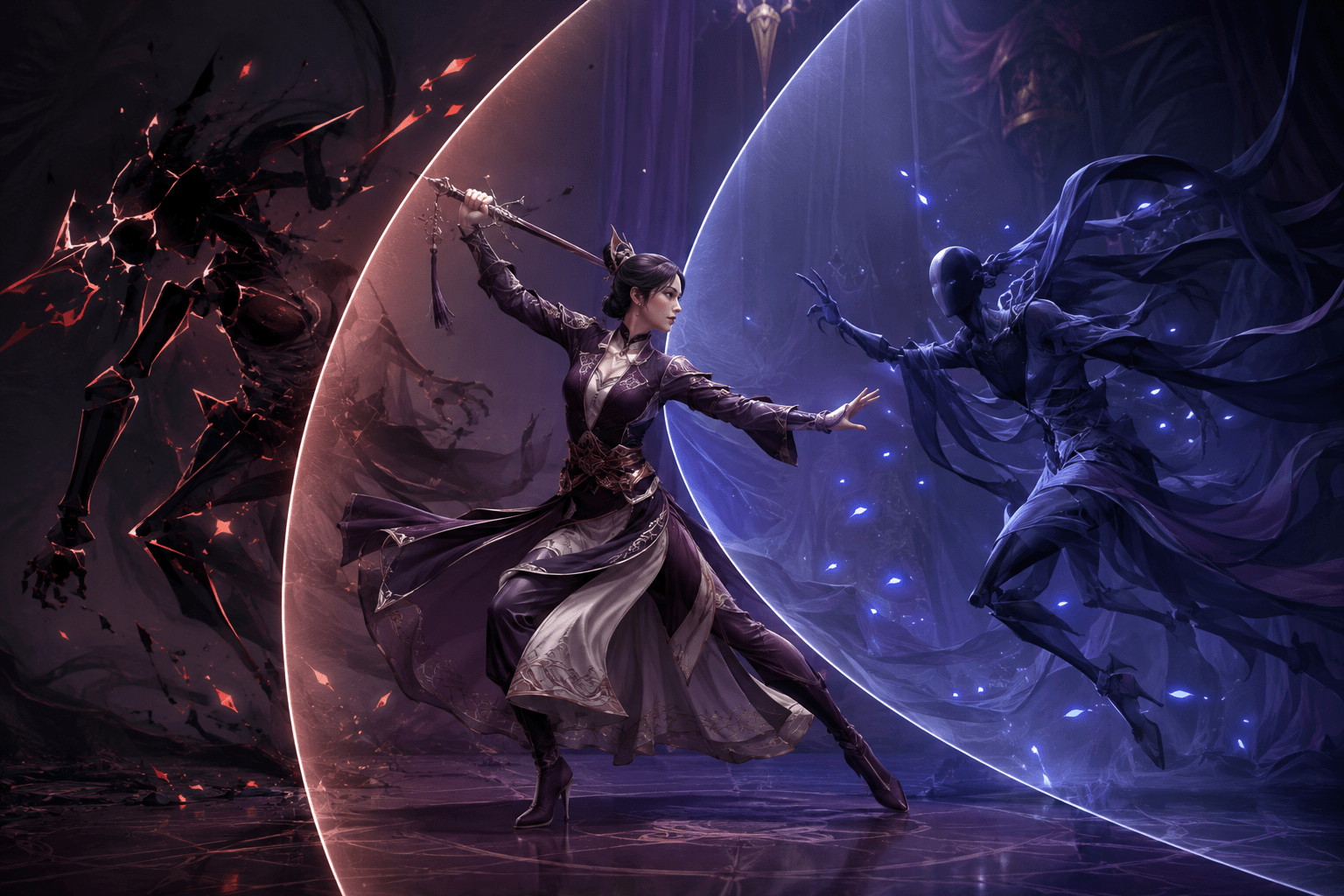
Bayonetta 3 combines fast fantasy combat with stylized violence, suggestive presentation, partial nudity, dramatic transformation sequences, and deliberately provocative humour. These elements are closely associated with the series’ visual identity, but they can also create barriers for players who want the action without every part of its default presentation.
Naive Angel Mode is an optional content-modification setting that reduces selected depictions of nudity and violence. Nintendo describes it as altering certain clothing choices, making some violent action scenes milder, and toning down other risqué elements.
The mode changes how supported material is presented. It does not remove the combat system, replace enemies, skip every affected scene, or convert the game into a nonviolent experience. The story and action continue, but selected visual details are made less explicit.
This distinction makes Naive Angel Mode different from a conventional content warning or scene-skip button. A warning tells the player that material is coming. A skip removes the player from a scene or interaction. Naive Angel Mode modifies parts of the material while allowing the player to remain present.
The mode changes presentation rather than difficulty
Naive Angel Mode has no documented effect on enemy health, damage, aggression, combat timing, scoring, or the complexity of the controls. It is not an easier difficulty level and does not perform any action for the player.
Bayonetta 3 separately provides Casual, Standard, and Expert difficulty modes. It also includes the Immortal Marionette accessory, which can automatically perform defensive actions and combinations from simpler button inputs. Those systems affect how combat is played.
Naive Angel Mode instead changes selected visual content. A player can use it while retaining whichever difficulty and combat configuration is otherwise appropriate. Someone who wants the original combat demands but less explicit presentation does not have to reduce mechanical challenge to obtain that change.
Conversely, someone who needs simplified combat may use Casual difficulty or the Immortal Marionette without enabling Naive Angel Mode. The settings address different barriers and should not be treated as interchangeable.
Selected clothing is altered
Nintendo specifically identifies altered clothing as one of the mode’s effects. The default game includes moments in which magical transformations, attacks, or other stylized sequences can leave characters partially unclothed. Naive Angel Mode changes supported appearances so that more clothing remains visible.
This may support players who are uncomfortable with partial nudity or sexualized presentation. It may also be relevant when playing in a shared room, around family members, during a streamed session, or in another context where the player wants to reduce those elements.
Changing clothing does not remove the characters’ bodies, poses, choreography, camera direction, dialogue, or overall visual style. A scene can remain suggestive even after exposed areas are covered. The mode should therefore not be described as eliminating all sexual content.
It also does not provide separate controls for every costume, pose, animation, or camera angle. Nintendo presents Naive Angel Mode as a single mode rather than a collection of granular switches for nudity, suggestive dialogue, framing, and costume coverage.
Some violence becomes milder rather than disappearing
Nintendo’s descriptions state that Naive Angel Mode decreases depictions of violence and makes some violent action scenes milder. The wording is deliberately limited: it refers to selected depictions, not the elimination of violence throughout the game.
Bayonetta 3 remains an action game centred on repeated battles. Characters attack enemies with weapons, magical abilities, summoned creatures, and large-scale finishing actions. Enemies remain visible, attacks still connect, and combat continues to drive progression.
The mode may reduce the explicitness of supported moments, but it does not offer pacifist play or replace opponents with harmless alternatives. It does not prevent the story from depicting danger, death, destruction, monsters, or threatening situations.
This is sensory reduction rather than complete trigger removal. A player who needs all violence, blood, body horror, or death-related content removed should not assume that the mode will meet that need.
Modification differs from concealment
Some games respond to disturbing material by placing a blurred or opaque shape over the screen. That approach conceals visual detail but may also hide action, character movement, environmental context, and information needed to follow the scene.
Naive Angel Mode is described as altering supported presentation rather than simply covering the display. Clothing can be changed and certain violent scenes can be made milder while the scene itself continues. This may preserve more narrative and visual continuity than a large concealment overlay.
The feature is also different from replacing an entire character model or enemy category. Spiders, for example, may be transformed into abstract shapes by an arachnophobia mode while retaining their mechanical role. Naive Angel Mode does not broadly replace Bayonetta 3’s characters or enemies. It adjusts selected details within their existing appearances and scenes.
The precise implementation varies according to the supported moment. The feature should not be assumed to apply one uniform transformation to every instance of nudity or violence.
The setting is not a content-warning system
A content warning provides information before a potentially difficult scene. It may name the type of content, indicate when it will begin, or allow the player to prepare before proceeding.
Naive Angel Mode does not provide scene-by-scene warnings. It is enabled as a broader presentation choice, and the game applies its predetermined changes when supported material appears.
This can reduce the need to respond to each individual scene, but it also means the player is not given a detailed inventory of what will remain. Someone with a specific trigger cannot use the setting to determine whether an upcoming chapter still contains that material.
The mode may therefore be combined with an external content guide when a player needs more precise information. A guide and Naive Angel Mode would serve different purposes: one describes content, while the other modifies selected depictions.
It does not function like a parental-control rating
The name “Naive Angel Mode” and its ability to reduce mature presentation may suggest a child-oriented setting, but it does not change the software’s official age classification or create a separate child-safe edition.
Nintendo’s North American listing continues to identify content including blood and gore, partial nudity, strong language, and violence. Enabling the mode does not alter that store rating. It also does not block access to settings, purchases, online functions, or other mature material through a password.
Platform parental controls can restrict software according to its rating, limit purchases, or control communication features. Naive Angel Mode does none of those things. It is an in-game presentation option, not an account-level supervision system.
A parent or caregiver evaluating the game still needs to consider its remaining combat, themes, language, narrative events, and overall rating rather than relying on the mode’s name.
The mode must be selected outside active chapter play
Nintendo’s update documentation describes an important operational limitation. Naive Angel Mode can be enabled when beginning the game, from the main menu, or through Options in Chapter Select. It cannot be changed from the Options menu while a chapter is being played.
This means it is not an immediate response button. A player who encounters unexpectedly uncomfortable material during a chapter cannot simply pause at that moment, enable the mode, and continue from the same point with the presentation changed.
The player may need to leave the active chapter, change the setting from an eligible menu, and then return. Depending on the game’s save and checkpoint state, that interruption may involve repeating some material or losing short-term progress.
Requiring advance selection can be a barrier when the player does not know what a chapter contains. It also makes experimentation less convenient because the visual difference cannot necessarily be compared from the pause menu during the affected scene.
An update expanded coverage
Version 1.1.0 added additional scenes to Naive Angel Mode and allowed players to enable it when beginning the game. This demonstrates that the mode’s coverage is based on specifically authored scene changes rather than a universal real-time filter.
A universal filter could theoretically identify and transform every matching image automatically. Adding coverage scene by scene suggests that developers prepared alternate presentation for particular moments. Material not included in that authored coverage will remain unchanged.
Players using a physical or older digital installation should apply the current game update to receive the expanded coverage. Nintendo states that the update is also required for the game’s online features.
The update improved the feature, but “additional scenes” does not mean every possible instance is now modified. Nintendo continues to use qualified language such as “decreases depictions” and “some” violent scenes.
The mode may address several different barriers
Players can avoid the same material for very different reasons. Some may experience distress around blood, gore, partial nudity, or sexualized presentation. Others may have trauma-related concerns, religious or cultural boundaries, sensory sensitivities, or preferences about what appears in a shared environment.
Naive Angel Mode may reduce certain barriers without implying that everyone with a particular diagnosis or background needs it. One player may want less nudity while being comfortable with fantasy violence. Another may be concerned primarily with explicit injury. Because the mode combines several changes, neither player can independently select only the relevant component.
That bundled design is convenient when the combined modification matches a player’s needs. It is less flexible when someone wants one category changed and another left intact.
The mode can also support contextual access. A player may use the default presentation in private but enable Naive Angel Mode when playing on a television visible to other people. Accessibility settings can be useful because of both individual sensory needs and the environment in which play occurs.
It cannot guarantee freedom from triggering content
Naive Angel Mode does not include a published, exhaustive list of every altered scene and every remaining depiction. Nintendo’s documentation confirms categories of changes but does not promise comprehensive removal.
Violent actions, threatening creatures, destruction, death, suggestive themes, strong language, dramatic camera work, and partial elements of the game’s mature tone can remain. The mode also does not remove flashing effects, rapid animation, screen movement, intense music, or combat sound.
A player with significant content-related access needs may need more information than the setting provides. External content databases, detailed reviews, recorded examples, or assistance from someone familiar with the game may be necessary to evaluate remaining material.
This limitation does not make the feature meaningless. Partial reduction can be the difference between tolerable and intolerable presentation for some players. It does mean that the option should be described accurately rather than promoted as a universal safe mode.
Platform restrictions are unusually narrow
Bayonetta 3 was released exclusively for Nintendo Switch. The game can also run on Nintendo Switch 2 through the system’s backward-compatibility support, but it remains the Nintendo Switch software rather than a separate Switch 2 edition.
There are no native PlayStation, Xbox, or PC versions in which the setting can be used. The feature is built into the game and is not a third-party mod, so its behaviour does not depend on external files or community support.
Naive Angel Mode can be enabled in both physical and digital copies once the necessary software updates are installed. Its scene coverage and menu restrictions are part of the game rather than differences between those purchase formats.
A selective filter with deliberately limited coverage
Nintendo’s official update history for Bayonetta 3 describes Naive Angel Mode as decreasing depictions of violence and nudity, confirms that additional scenes received support, and explains where the setting can be changed.
The feature is valuable precisely because it does not require players to abandon the game’s combat in order to reduce selected mature imagery. It alters presentation while leaving encounters and narrative continuity largely in place.
Access needs vary, however. Naive Angel Mode may make specific clothing and violent scenes less explicit, but it does not remove all nudity, suggestive framing, violence, gore, threatening imagery, or other intense sensory content—and it cannot be activated directly from the Options menu during an active chapter.