
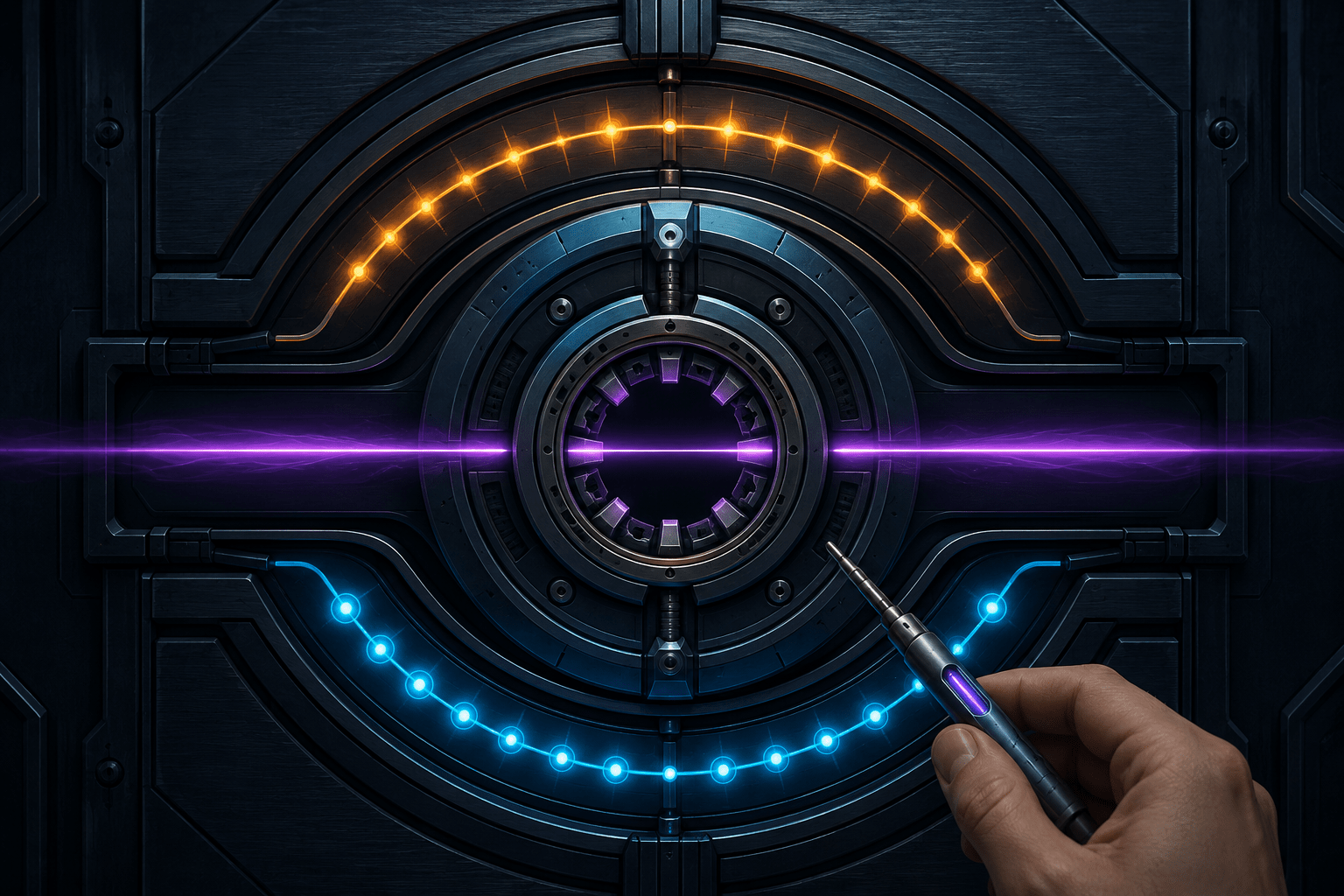
Lockpicking in Star Wars Outlaws is built as a rhythm minigame. Instead of manually rotating a conventional lockpick, the player uses a data spike and responds to a repeating pattern. The standard interaction asks the player to identify its beat and reproduce that timing through button presses.
This design combines auditory perception, rhythm recognition, working memory, reaction timing, and motor execution. A player may understand what the lock requires but still be unable to hear the pattern clearly, remember its sequence, or activate the input at the required moments.
Rather than tying all of those demands to one general difficulty preset, Star Wars Outlaws provides several settings specifically for lockpicking. Players can enable visual rhythm cues, lower the lockpicking difficulty, or turn off the lockpicking rhythm challenge altogether.
These options are related, but they are not interchangeable. Visual cues translate the rhythm into another sensory channel. Lower difficulty retains the minigame while reducing its demands. Disabling the rhythm challenge removes the timing test. Understanding those differences can help players choose the setting that addresses their actual barrier.
How the standard rhythm interaction works
The lockpicking sequence presents a repeating auditory pattern. The player listens to the rhythm and presses the appropriate input in time with its beats. The challenge is not simply recognizing that a sound occurred. The player has to identify the pattern, anticipate its timing, and reproduce it with sufficient precision.
That requires multiple stages of processing. First, the sound must be audible and distinguishable from other audio. The player then has to separate individual beats, understand how the pattern repeats, retain that sequence long enough to act, and coordinate a motor response with each required point.
Rhythm can be a distinct access barrier even for someone who can hear the sound. Hearing a pattern does not guarantee that a person can identify its structure or translate it into synchronized button presses. Auditory-processing differences, attention changes, working-memory demands, fatigue, or difficulty perceiving timing can all affect the interaction.
The motor component is also separate from rhythm recognition. A player may know exactly when an input is required but be unable to press quickly or consistently enough. Tremor, pain, muscle weakness, reduced dexterity, delayed movement, and adaptive-input latency may all affect performance.
The repeated nature of lockpicking matters as well. A player who can complete one simple rhythm under ideal conditions may have difficulty when patterns become more complex, when concentration is reduced, or when the action occurs during a longer session.
Visual cues provide another sensory channel
The Lockpicking Visual Cues option supplements the auditory pattern with visual information. Instead of requiring the player to rely entirely on hearing the rhythm, the game provides an on-screen indication of the moments associated with the beats.
This is an example of redundant communication. The same essential timing information is available through more than one sensory channel. A deaf or hard-of-hearing player can use the visual representation, while someone with inconsistent auditory processing may combine the visual and auditory signals.
Visual cues are more substantial than subtitles. Subtitles represent spoken language, and captions can identify environmental sounds. A rhythm cue must communicate timing with enough precision for the player to act. A generic caption reading “lock clicking” would acknowledge the sound without necessarily showing when each input is expected.
Providing a synchronized visual signal may also help players who can hear the pattern but find it difficult to organize. Seeing the intervals can make the rhythm’s structure more explicit. The visual and auditory channels may reinforce each other, reducing the need to derive the complete pattern from sound alone.
The option does not remove the timing requirement. A visual cue still has to be noticed, processed, and answered at the required moment. It changes how the information is communicated rather than automatically completing the sequence.
That distinction is important for players with visual-processing or reaction-time barriers. Turning on visual cues may help when the problem is hearing the beat, but it may not help when the primary difficulty is producing a sufficiently precise response.
Visual assistance is not automatically accessible to everyone
A visual version of an auditory cue does not make the minigame universally accessible. Players with low vision may have difficulty locating or distinguishing the indication. Rapid changes, competing screen elements, or the need to watch several parts of the lock can still create barriers.
Some players may also find repeated visual pulses distracting or uncomfortable. Individual sensory needs can conflict: an added visual cue may reduce auditory reliance while increasing visual load.
The game’s broader interface settings may help with some presentation barriers, but they do not guarantee that the timing cue will be usable in every viewing situation. Screen size, handheld play, display brightness, contrast, and environmental lighting can affect visibility.
For players who cannot reliably use either the auditory pattern or its visual equivalent, reducing or disabling the challenge may be more appropriate than adding another cue.
Lowering lockpicking difficulty retains the minigame
The separate Lockpicking Difficulty setting changes the challenge level without necessarily removing the rhythm interaction. This is simplification rather than automatic completion.
Lower difficulty may provide more forgiving timing or precision requirements. Ubisoft’s accessibility documentation describes minigames as having individual settings for timing, precision, and visual assistance, although it does not publicly quantify the exact timing windows for each lockpicking level.
This option may suit someone who wants to participate in the rhythm mechanic but needs a less exact response. A wider tolerance can reduce the likelihood that a slightly early or late press invalidates an otherwise correctly understood pattern.
It may also help when motor performance varies. Someone experiencing fatigue, pain, or inconsistent movement may benefit from additional tolerance without wanting to bypass the interaction completely.
Lower difficulty still preserves the basic requirement to recognize and answer the pattern. It should not be described as an automatic lock-opening option. Players who cannot perceive the rhythm or perform timed inputs at all may continue to encounter a barrier even at the easiest setting.
Turning off the rhythm challenge removes the timing test
The Lockpicking Rhythm Challenge setting provides a more substantial alternative. Ubisoft states that players can turn off minigame requirements involving precise inputs, and its dedicated lockpicking documentation identifies an option for disabling the rhythm challenge.
With the rhythm component disabled, the player no longer has to reproduce the beat sequence. This removes the minigame’s central auditory-memory and precision-timing test rather than merely making it more forgiving.
The surrounding interaction remains intentional. The player still finds the lock, approaches it, and chooses to use the data spike. Disabling the rhythm challenge does not automatically locate every locked door, navigate the player to it, or open locks before the player interacts with them.
This is therefore a minigame bypass rather than broad environmental automation. It resolves the lock once the relevant interaction has been initiated without automating the exploration that led to it.
The difference matters because a player may enjoy searching an area, deciding whether to enter a restricted space, and finding locked containers while being unable to complete the rhythm test. Removing the minigame allows those surrounding decisions to remain part of play.
Assistance versus automatic resolution
The three settings form a useful progression of support. Visual cues retain the original timing challenge but communicate it through another channel. Lower difficulty retains the challenge while reducing its precision. Turning off the rhythm challenge removes the timed sequence.
None is inherently the “correct” accessibility choice. The appropriate setting depends on the barrier and on how much of the interaction the player wants to retain.
A deaf player who is comfortable with visual timing may use visual cues at the standard difficulty. Someone with slower motor responses might combine the cues with easier timing. A player who cannot reliably perform rhythm-based inputs may disable the challenge entirely.
Providing these choices avoids treating all difficulty as one problem. Auditory access, rhythm processing, memory, reaction time, and motor precision are different demands. A single easy mode cannot reliably address each of them.
Combining visual cues with lower difficulty
The lockpicking settings can be combined rather than used in isolation. Visual cues can make the beat available without sound, while reduced difficulty can make the response window more forgiving.
This combination may help when the player has overlapping hearing and motor barriers. The visual cue communicates when to act, and the lower difficulty reduces the precision required when producing the action.
It may also support players who benefit from multimodal information. Hearing and seeing the rhythm together can reduce the amount of information that must be inferred from a single channel. Easier timing can then reduce the consequence of small delays while integrating those signals.
The combination does not eliminate all processing. The player must still attend to the sequence, understand the cue, and respond. If those stages remain inaccessible, turning the rhythm challenge off offers a qualitatively different solution.
Combining lockpicking settings with other controls
Star Wars Outlaws supports controller remapping, keyboard-and-mouse remapping on PC, controller presets, adjustable deadzones, sensitivity settings, and an option that changes many held inputs into presses.
Remapping may place the lockpicking action on a control that is easier to reach. It can support a different hand position or adaptive-controller layout. However, remapping alone does not change when the input must be activated.
This makes remapping complementary to the lockpicking options. A player can first make the action physically reachable, then use visual cues, lower difficulty, or remove the rhythm test according to their timing and sensory needs.
Input changes can also introduce trade-offs. Moving the action to an easier button may displace another command or create conflicts elsewhere. Because Star Wars Outlaws includes on-foot movement, vehicles, spaceflight, stealth, and minigames, one layout may not be equally comfortable in every context.
Menu narration and the minigame
Ubisoft’s updated accessibility documentation states that expanded menu narration covers lockpicking and slicing minigames. This may provide spoken access to relevant interface information for blind and low-vision players.
Menu narration should not be confused with the rhythm itself. Narrating a setting, prompt, or minigame state does not necessarily make a real-time timing sequence independently playable. A blind player may still face barriers involving environmental navigation, locating locks, or interpreting the active rhythm interaction.
Turning off the rhythm challenge may remove one of those barriers, but it does not establish that the complete game or every step leading to the lock is accessible without sighted assistance. Ubisoft itself describes audio description as potentially useful to blind players playing with sighted assistance, rather than claiming complete nonvisual access.
The relationship to sound and cognitive load
The standard lockpicking rhythm occurs within a game that can contain dialogue, environmental sound, music, and nearby threats. Even if the minigame emphasizes its beat, the player may be managing several auditory sources.
Star Wars Outlaws includes a Focus Mode that hides less important sounds so critical audio can be easier to hear. It also separates gameplay and background sound-effect volumes and uses dynamic mixing rules to reduce lower-priority sounds in some situations.
Those features may make an auditory rhythm easier to distinguish, but they do not remove the need to memorize or reproduce it. A clearer beat can still be inaccessible when rhythm recognition, timing, or motor execution is the barrier.
Conversely, turning on visual lockpicking cues does not reduce all cognitive load. Watching the timing indication may compete with monitoring the environment, especially if lockpicking occurs in a location where the player is concerned about detection.
What the lockpicking settings do not solve
Disabling the rhythm challenge removes the lock’s timing requirement, but it does not automatically identify every locked object. Players must still explore, visually or otherwise recognize possible interactions, move into position, and initiate the data-spike action.
The setting also does not bypass unrelated minigames. Star Wars Outlaws provides individual configuration for different minigames, meaning a change to lockpicking should not be assumed to alter slicing, Sabacc, or other activities.
Visual cues do not provide a universal replacement for audio. Their readability may depend on vision, attention, display conditions, and the clarity of the cue. Lower difficulty does not remove timing. Disabling timing does not remove every control or navigation requirement.
Players should also avoid assuming that “rhythm challenge off” removes all danger surrounding a lock. If a lock is situated in a restricted or hostile location, environmental stealth and detection systems can still apply.
Platform availability
Ubisoft’s current accessibility spotlight states that Star Wars Outlaws is available on PlayStation 5, Xbox Series X|S, Nintendo Switch 2, and Windows PC through Ubisoft Connect, Steam, and the Epic Games Store.
The spotlight presents the lockpicking options as part of the game’s current accessibility feature set. It also documents a Nintendo Switch 2 handheld preset that changes interface presentation for the smaller display. Handheld players may still need to test whether visual rhythm cues are sufficiently clear at their chosen screen distance.
Control prompts and remapping capabilities differ by platform and input device. The functional distinction among visual cues, lower difficulty, and disabling the rhythm challenge remains the same, but the physical input used for lockpicking may vary.
Three settings for three different barriers
Ubisoft’s official lockpicking support documentation identifies dedicated settings for adjusting the minigame rather than requiring players to change the difficulty of the entire game.
Visual cues provide a non-auditory representation of the beat. Lower difficulty reduces the precision of the challenge while retaining participation. Turning off the rhythm challenge removes the timed pattern when assistance is not enough.
Access needs vary, and none of these settings resolves every navigation, visual, cognitive, or input barrier in Star Wars Outlaws. Their practical value is their separation: players can change how the rhythm is communicated, how strictly it is judged, or whether it is required at all.