
A standard controller thumbstick assumes that the player can reach a small circular surface, maintain contact with it, and move it accurately through a limited range. Its height, width, curvature, and texture are fixed by the controller manufacturer. That design may work well for many players, but it does not accommodate every grip, body part, movement pattern, or amount of available strength.
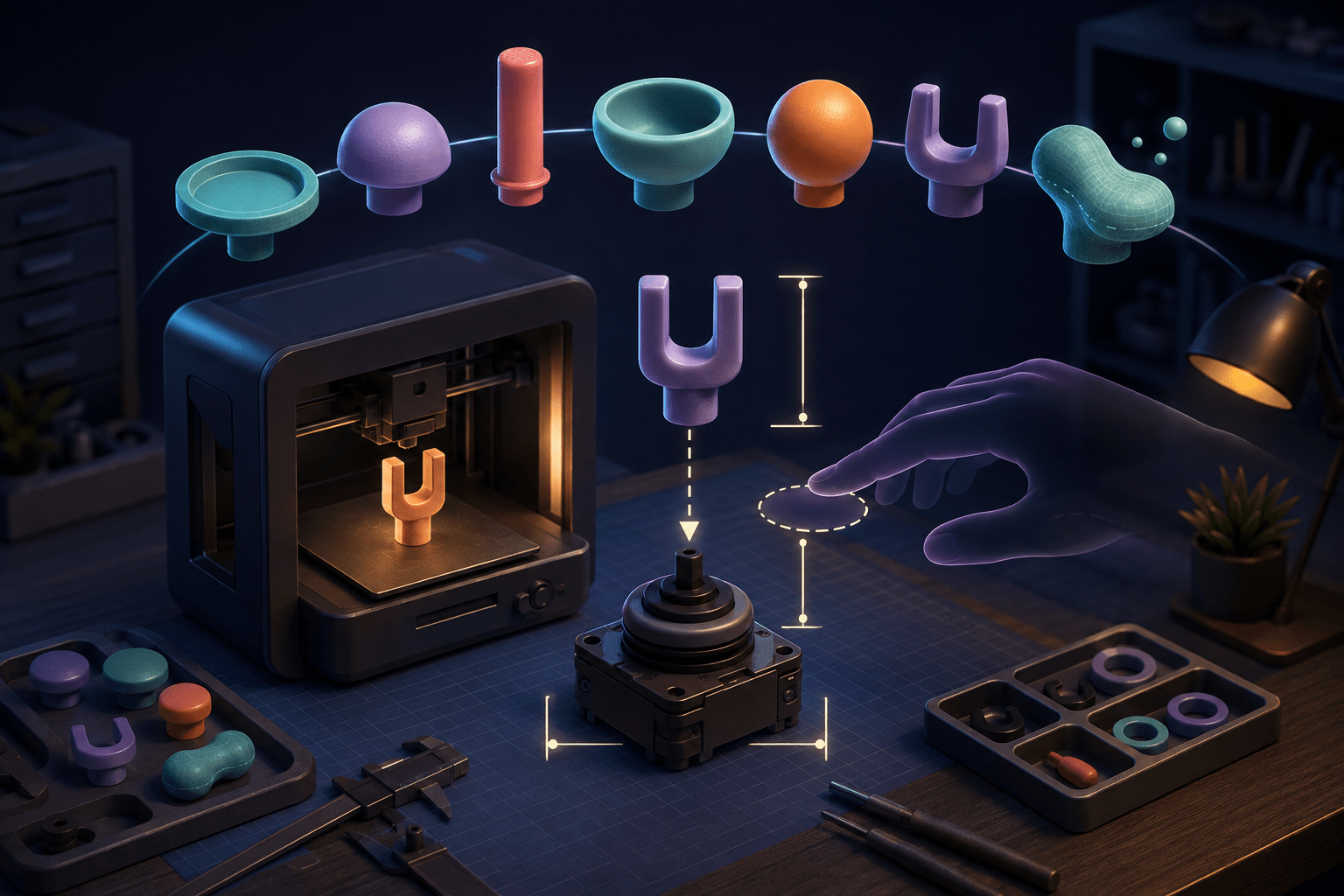
Xbox Design Lab provides free customizable files for seven adaptive thumbstick topper shapes. Players choose a compatible controller, select a topper shape, adjust its height and width, and download a file for 3D printing. The printed part is then attached to the controller’s existing thumbstick or installed in place of it, depending on the controller.
The toppers change the physical point where the player contacts the stick. They can provide a larger surface, a taller lever, a recessed area, a rounded shape, or another form that may be easier to push, pull, surround, or operate with a different body part.
They do not change the controller’s electronic input, enlarge the analogue range detected by the game, or automate movement. Their purpose is mechanical: altering the shape and leverage through which the player operates the existing stick.
Seven Different Contact Shapes
The current Xbox Design Lab program offers seven topper shapes. The original collection included Plate, Dome, Stick, Pull, Sphere, and Custom designs. In May 2026, Xbox added a seventh Goal Post shape and introduced an improved attachment design intended to remain secure during higher-force use.
The Plate topper provides a broad, shallow surface with an indentation. Microsoft describes it as an option that can be operated with larger body parts, including the chin. Its wider contact area may reduce the precision required to remain centred on a small conventional thumbstick.
The Dome uses a rounded convex surface. A player can contact the outside of the dome rather than fitting a finger or another body part into a recessed shape. Microsoft identifies it as an option for different grip strengths and dexterity needs.
The Stick topper extends the control upward with a narrow cylindrical form. Its additional height increases the available leverage. A player may be able to move the underlying joystick with less force because the point of contact is farther from the stick’s pivot.
The Pull topper uses a deeper bowl-shaped surface. It can surround a thumb, finger, stylus, or similar point of contact, reducing the need to maintain pressure against a small exposed cap. A recessed shape may make pulling and directional movement more stable for some players.
The Sphere provides a smooth ball-shaped contact point. It may support operation through grasping or contact from a wider range of angles. Unlike a shallow cap, the sphere provides a three-dimensional surface around which the hand or another body part can be positioned.
The Custom topper is intended to support a player-created contact form. Microsoft describes it as offering increased adhesion for shapable materials such as clay, allowing another material to be formed around the player’s preferred contact shape.
The newer Goal Post shape has two raised sides with an open centre. Xbox added it in response to player requests. Its forked shape can provide side surfaces against which the player can push or pull without requiring the same type of contact as a conventional rounded stick.
These descriptions explain the physical intentions of the designs, not guaranteed disability benefits. A recessed shape that stabilizes one player’s movement may restrict another player’s preferred release. A taller stick may reduce required force while increasing the distance travelled at its top. The appropriate form depends on how the person approaches and moves the control.
Changing Height and Width
Xbox Design Lab allows the topper’s height and width to be customized before the 3D-printable file is generated. The dimensions can be adjusted to the millimetre rather than being limited to a single predetermined size for each shape.
Width changes the available contact area. A broader plate or bowl may be easier to locate and maintain contact with. It may allow operation with the palm, side of the hand, chin, foot, or another body part that cannot reliably use a small thumbstick cap.
A wider topper also occupies more physical space. It may interfere with nearby buttons, another stick, the controller shell, or the player’s hand position if it is made too large. The practical maximum is therefore affected by the controller layout and the direction from which the player approaches it.
Height changes leverage. A taller topper creates a longer lever above the joystick’s pivot. This may reduce how much force the player must apply to move the stick, which can help when the standard resistance is difficult to overcome.
Increased leverage has trade-offs. The top of a tall stick travels farther when the underlying joystick moves through the same angle. A player may need to make a larger physical movement to reach the edge of the stick’s range. A tall or heavy topper can also make the control feel less responsive.
Microsoft’s printing recommendations state that shorter and smaller toppers provide better performance. Customization therefore involves balancing access against responsiveness. The most accessible dimension is not necessarily the largest one.
Shape Modification Is Different From Sensitivity Adjustment
A thumbstick topper changes the player’s physical interaction with the joystick. A sensitivity setting changes how the game interprets the joystick’s electronic position.
A taller topper may allow finer physical movement because a small angular change at the joystick produces a larger movement at the top of the extension. That mechanical difference does not automatically change the in-game sensitivity curve. The game still receives the position reported by the controller.
If the camera moves too quickly after a taller topper is installed, the player may need to adjust look sensitivity or acceleration within the game. If reaching the full edge of the stick is difficult, an available dead-zone or maximum-input setting may also help, but those options depend on the game or controller software.
The topper cannot add a sensitivity menu to a game that lacks one. It also cannot correct stick drift, create digital directional inputs, or change which stick controls movement and camera orientation. Remapping and software settings address those separate issues.
Mechanical and software customization can nevertheless be combined. A player might use a tall Pull topper to reduce required force, remap the sticks if the software permits it, and reduce camera sensitivity for more controllable movement.
Compatible Xbox Controllers
Xbox provides adaptive topper files for the Xbox Wireless Controller, Xbox Elite Wireless Controller Series 2, and Xbox Adaptive Joystick. The player selects the intended controller before designing the topper because the attachment method and base geometry differ.
For the standard Xbox Wireless Controller, the printed topper uses a locking adapter made from two clip halves placed around the existing thumbstick. The topper is inserted into the adapter and rotated to lock it in position.
The Xbox Elite Wireless Controller Series 2 uses removable thumbsticks. Microsoft instructs players to remove the installed thumbstick before fitting the adaptive replacement. The lower edge of the printed part must be clean because printing residue can prevent it from seating correctly.
The Xbox Adaptive Joystick has its own compatible topper files and attachment design. It is a separate wired joystick with customizable buttons that can be used in several adaptive arrangements.
The files are controller-specific. A topper generated for one attachment system should not be assumed to fit another controller. Microsoft states that the designs are for supported Xbox controllers rather than universal joystick accessories.
The Improved 2026 Attachment
Xbox updated the topper system in May 2026 after receiving player feedback. The revised attachment design is intended to better withstand higher-force use and remain securely attached during gameplay.
This is important because not every player operates a joystick with light fingertip pressure. A topper may be pushed with the palm, foot, chin, forearm, or another body part. The direction and amount of force can differ considerably from the conditions assumed by a standard thumbstick cap.
A loose topper can rotate, lift, or disconnect at the moment an input is needed. Improving the attachment may make the accessory more dependable for players who apply greater lateral or downward force.
The update does not mean that every print will attach perfectly. Printer calibration, material, dimensional tolerances, support removal, and post-processing can all affect fit. The revised design addresses attachment durability, but the quality of the produced part remains relevant.
The Files Are Free, but the Printed Parts Are Not Supplied
Xbox Design Lab generates the 3D-printable file without charging a download fee. A player does not have to purchase a new controller through Design Lab to obtain the file.
Xbox does not print or mail the topper. The player needs access to a 3D printer or a printing service. A library, makerspace, educational facility, community organization, or commercial service may be able to produce the part when the player does not own a printer.
This distinction creates a meaningful access limitation. A free digital file is not the same as a free finished accessory. Printing can involve material costs, service fees, travel, shipping, communication with a printing provider, and repeated attempts if the first result does not fit correctly.
A player may also need help using the Design Lab configurator, downloading the file, transferring it to printing software, choosing print settings, removing supports, cleaning the part, and assembling it safely.
The workflow can be particularly difficult for someone whose disability makes small-part assembly, sanding, scraping, or computer-based design interfaces inaccessible. The final topper may reduce a gameplay barrier while the production process creates barriers of its own.
Printing Material, Weight, and Responsiveness
Microsoft recommends printing the toppers in ABS plastic because it withstands wear and can reduce debris falling into the controller. It also recommends 10% infill.
Infill determines how much internal material is used inside the printed object. Increasing it generally makes a part heavier. Microsoft warns that a heavier topper can make the controller less responsive, which is why the recommended print uses a relatively low fill percentage.
The relationship between weight and responsiveness is especially important for tall shapes. Additional mass farther from the joystick’s pivot can influence how the stick returns to centre and how easily the player changes direction.
A very light part may respond better but must still be durable enough for the player’s method of operation. Someone who applies substantial force may need to consider the improved attachment design, print quality, material strength, and shape dimensions together.
Microsoft does not guarantee that a generated design will work for every player. Printed dimensions can vary because different printers and settings produce slightly different tolerances.
Print Orientation and Post-Processing
The orientation used during printing affects different areas of the finished part. Microsoft states that printing a topper upright can produce a cleaner finish on the surface the player touches. Printing it upside down can produce a better-quality connection to the controller, particularly for the standard-controller and Xbox Adaptive Joystick versions.
Support structures may be required while printing shapes with overhangs. Microsoft recommends organic or tree-style supports because they are generally easier to remove. It advises avoiding rafts and brims where possible because they can increase the amount of cleanup required.
For the Elite controller version, residue around the base can prevent the part from seating correctly. Removing supports or excess plastic may require scraping or sanding after the print has cooled.
Surface finish is an accessibility consideration as well as a cosmetic one. Rough edges, support marks, sharp fragments, or an uneven contact area may be uncomfortable during repeated use. A part intended for contact with the face, chin, hand, or foot needs to be inspected before use.
Post-processing can alter the dimensions if too much material is removed. Cleaning the attachment area must therefore be done carefully enough to preserve the fit.
Alternative Contact Does Not Remove Every Motor Demand
A larger or better-shaped topper may make the stick easier to reach, push, pull, or hold. It does not eliminate the need to move the stick through the directions and distances required by the game.
Some games demand rapid changes between opposite directions, precise aiming, simultaneous stick clicks, or continuous use of both sticks. A topper may help with directional control while the stick-click action remains difficult. It may also make clicking harder if the increased height changes how downward force is applied.
The topper does not move buttons, change trigger resistance, or provide access to the rest of the controller. A complete adaptive setup may still require remapping, external switches, Controller Assist, Toggle Hold, mounting equipment, or another controller arrangement.
The physical space around the controller must also be considered. A large topper may collide with a mounting surface or interfere with another control. A design that works on a handheld controller may require different dimensions when the controller is fixed to a table or mount.
Customization Through Iteration
The ability to generate multiple files allows players to test different shapes and dimensions. Xbox does not limit how many topper files a person can create.
This makes iteration possible, but each physical test may require another print. A player may discover that a taller stick reduces force but increases fatigue because it requires too much travel. A wide plate may be easy to locate but obstruct a nearby button. A deep bowl may improve stability but make rapid release difficult.
Those results are not design failures. They demonstrate why a fixed accessory cannot represent every access need. Shape, width, height, material, controller position, body movement, and software sensitivity interact.
Whenever possible, testing should consider the actual game actions the player needs to perform rather than evaluating the topper only while the controller is disconnected. A shape that feels comfortable at rest may behave differently during rapid camera movement or sustained directional input.
A Mechanical Access Tool With Production Barriers
The current Xbox Design Lab adaptive thumbstick topper page provides the configurator, compatible-controller options, printing recommendations, and assembly guidance.
The toppers can change a joystick’s contact area, containment, height, width, and leverage without replacing the controller’s electronic stick mechanism. Seven available forms—including the newer Goal Post design—provide different ways to push, pull, surround, grasp, or approach the control.
They do not arrive as finished products, fit non-supported controllers universally, change in-game sensitivity automatically, or guarantee accessible joystick use. Access needs vary, and printing, cleanup, assembly, weight, responsiveness, fit, and nearby controls all impose practical limits. Their value lies in making the physical shape of an Xbox thumbstick customizable when the standard cap is itself the barrier.